INTERVIEWERSadly, only the excerpt is available right now. For many others, you can download full PDFs of the interviews.
Isn’t there an enormous temptation as a fiction writer to take scenes out of history, since you do rely on that so much, and fiddle with them just a little bit?
DOCTOROW
Well, it’s nothing new, you know. I myself like the way Shakespeare fiddles with history. And Tolstoy. In this country we tend to be naive about history. We think it’s Newton’s perfect mechanical universe, out there predictably for everyone to see and set their watches by. But it’s more like curved space, and infinitely compressible and expandable time. It’s constant subatomic chaos. When President Reagan says the Nazi S.S. were as much victims as the Jews they murdered—wouldn’t you call that fiddling?
Monday, July 31, 2006
More EL Doctorow
From the Paris Review's endlessly fascinating DNA of Literature feature, an excerpt from EL Doctorow's interview back in 1986.


Sunday, July 30, 2006
Sunday at Borders - 30 July
New and reviewed this week in History and Historical Fiction.
History
Ghost Hunters: William James and the Search for Scientific Proof of Life After Death by Deborah Blum (reviewed by Dennis Drabelle in the Washinton Post) -- Drabelle makes Blum's book sound like just another delve into those wacky Victorians and their crazy sublimation of sex into the supernatural. But medium Euspasia Palladino, who "liked to take off her clothes during her spells and often woke up avid to make love," sounds like she could support a book of her own.
Archie and Amelie: Love and Madness in the Gilded Age by Donna M. Lucey (reviewed by Francine Prose in the Washington Post) -- He was an Astor family scion who escaped from the Bloomingdale Asylum; she was a breathless novelist from a fading Southern family: together, they were a total disaster. Francince Prose makes this turn-of-the-last-century biography sound cheerfully lurid.
The Librettist of Venice: The Remarkable Life of Lorenzo Da Ponte, Mozart's Poet, Casanova's Friend, and Italian Opera's Impresario in America by Rodney Bolt (reviewed by Megan Marshall in the New York Times) -- Da Ponte, a poet who slept his way through eighteenth-century Europe and wrote the libretto for La Nozze di Figaro, sounds interesting enough. But the insanely long subtitle and reviewer's tendency to focus on her own failed book pitches make me much less inclined to read about him.
Historical Fiction
Triangle by Katharine Weber (reviewed by Frances Itali in the Washington Post) -- Itani isn't entirely sure what she thinks of this novel about modern characters with unusual ties to New York's 1911 Triangle Fire, but she knows she loves the first person plural ("We feel we must grieve ..."). The novel could be intreresting, or it could just be a melange of postmodern metafictional techniques -- hard to say.
Brookland by Emily Barton (reviewed by Christopher Benfey in the New York Review of Books [subscription required]) -- The Brooklyn Bridge, designed by John Augustus Roebling, opened in 1883 -- but what if a woman had tried building it seventy years earlier? Barton's novel, which combines fictional letters with narration "reconstructed" from other letters, sounds oddly compelling.
History
Ghost Hunters: William James and the Search for Scientific Proof of Life After Death by Deborah Blum (reviewed by Dennis Drabelle in the Washinton Post) -- Drabelle makes Blum's book sound like just another delve into those wacky Victorians and their crazy sublimation of sex into the supernatural. But medium Euspasia Palladino, who "liked to take off her clothes during her spells and often woke up avid to make love," sounds like she could support a book of her own.
Archie and Amelie: Love and Madness in the Gilded Age by Donna M. Lucey (reviewed by Francine Prose in the Washington Post) -- He was an Astor family scion who escaped from the Bloomingdale Asylum; she was a breathless novelist from a fading Southern family: together, they were a total disaster. Francince Prose makes this turn-of-the-last-century biography sound cheerfully lurid.
The Librettist of Venice: The Remarkable Life of Lorenzo Da Ponte, Mozart's Poet, Casanova's Friend, and Italian Opera's Impresario in America by Rodney Bolt (reviewed by Megan Marshall in the New York Times) -- Da Ponte, a poet who slept his way through eighteenth-century Europe and wrote the libretto for La Nozze di Figaro, sounds interesting enough. But the insanely long subtitle and reviewer's tendency to focus on her own failed book pitches make me much less inclined to read about him.
Historical Fiction
Triangle by Katharine Weber (reviewed by Frances Itali in the Washington Post) -- Itani isn't entirely sure what she thinks of this novel about modern characters with unusual ties to New York's 1911 Triangle Fire, but she knows she loves the first person plural ("We feel we must grieve ..."). The novel could be intreresting, or it could just be a melange of postmodern metafictional techniques -- hard to say.
Brookland by Emily Barton (reviewed by Christopher Benfey in the New York Review of Books [subscription required]) -- The Brooklyn Bridge, designed by John Augustus Roebling, opened in 1883 -- but what if a woman had tried building it seventy years earlier? Barton's novel, which combines fictional letters with narration "reconstructed" from other letters, sounds oddly compelling.
Saturday, July 29, 2006
Raw Data
As part of a larger thing I'm thinking about, I plugged the words "historical fiction" into Amazon. The number one result? Read on... Historical Fiction: Reading Lists for Every Taste.
I suppose it makes sense that a reading list would show up first -- what else is likely to have "historical fiction" in the title? But I still find it interesting that you'd nead a reading list to figure out what historical fiction is out there.
Two other things. One, "Customers who bought this item also bought:"
The Husband by Dean Koontz
Water for Elephants: A Novel, by Sara Gruen
The Hard Way (Jack Reacher Novels), by Lee Child
Read On ... Horror Fiction (Read On Series), by June Michele Pulliam.
And people who viewed this item also bought:
Katherine, by Anya Seton (93% of them!)
A Catch of Consequence, by Diana Norman, and
Sophie's Diary: A Historical Fiction, by Dora Musielak
Follow up on this later.
I suppose it makes sense that a reading list would show up first -- what else is likely to have "historical fiction" in the title? But I still find it interesting that you'd nead a reading list to figure out what historical fiction is out there.
Two other things. One, "Customers who bought this item also bought:"
The Husband by Dean Koontz
Water for Elephants: A Novel, by Sara Gruen
The Hard Way (Jack Reacher Novels), by Lee Child
Read On ... Horror Fiction (Read On Series), by June Michele Pulliam.
And people who viewed this item also bought:
Katherine, by Anya Seton (93% of them!)
A Catch of Consequence, by Diana Norman, and
Sophie's Diary: A Historical Fiction, by Dora Musielak
Follow up on this later.
Friday, July 28, 2006
A Complete History of Exactly One Thing
So, a little while back, my fiancee and I started noticing a publishing trendlet in history books. Some authors were taking single, narrow subjects, and using them to tell whole histories. The high-concept certainly isn't new (Daniel Yergin wrote The Prize -- an excellent history of oil -- back in 1993). And some titles sounded intriguing. (Opium, anyone?) But suddenly, the center table at Barnes & Noble seemed filled with titles like Salt, Cod, and Brick.
Turns out, we weren't the only ones to notice.
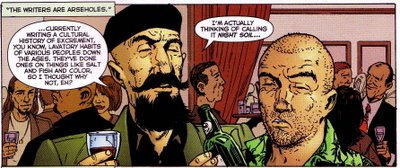
Garth Ennis, ladies and gentlemen. Not exactly a surgical strike, but you know when he's hit you.
Turns out, we weren't the only ones to notice.

Garth Ennis, ladies and gentlemen. Not exactly a surgical strike, but you know when he's hit you.
First Defeat (1939) by Alberto Méndez
The fiction in this week’s New Yorker, a short story about an officer’s surrender during the Spanish Civil War, has a couple of techniques worth noting.
The (sadly, late) Alberto Méndez tells the story in a first-person plural voice that suggests either a committee trying to reconstruct action, or a team of researchers presenting a paper.
What’s nice is, the point-of-view goes a long way toward developing one of Mendez’s themes, which is the difficulty of knowing what is in someone’s head as they take certain actions.
The narrators rarely use quoted dialogue unless it’s attributable to some other source. The few times they do, they admit they’re speculating. And it’s this admission that hooked me into the story.
The (sadly, late) Alberto Méndez tells the story in a first-person plural voice that suggests either a committee trying to reconstruct action, or a team of researchers presenting a paper.
What’s nice is, the point-of-view goes a long way toward developing one of Mendez’s themes, which is the difficulty of knowing what is in someone’s head as they take certain actions.
The narrators rarely use quoted dialogue unless it’s attributable to some other source. The few times they do, they admit they’re speculating. And it’s this admission that hooked me into the story.
These speculations about our hero’s thoughts are simply our way of explainingThe voice, which is brimming with limitations like these, makes the story feel like actual history. But it also suggests a pair of questions that serve as subtext for the story. What was Alegría really thinking when he surrendered? And, why do these narrators care enough to track down records and witnesses long after the fact?
the events we know to have occurred. We know that Alegría studied law, first in
Madrid, and then in Salamanca. We know from his relatives that he received a
country gentleman’s education in Huérmeces, in the provinces of Burgos, where he
was born, in 1912, to an aristocratic family of old Castilian stock, and reared
in a rambling house with two stone archways and a coat of arms that
distinguished its inhabitants from the local parvenus who owed their fortunes to
famines in the south, where livestock, vines, corn, and olives had succumbed to
anthrax, phylloxera, weevils, oidium, and other curses.
Thursday, July 27, 2006
The Duke of Wellington Misplaces His Horse
Susanna Clarke, who wrote the excellent historical fantasy Jonathan Strange and Mr. Norrell, has an audio version of her new short story (set in the universe of Neil Gaiman's comic fantasy Stardust) up on British Radio 4. Like most of her shorter work (some of which has graced the Op-Ed page of the New York Times), it's a polished little gem, and it has enough real history in it to qualify as more than just "period fantasy." The audio version is only up for a week, although the story will appear in her upcoming collection The Ladies of Grace Adieu and Other Stories.
Assassins!
So, last week, I saw a performance of Stephen Sondheim’s Assassins! at the Signature Theater in Arlingon, Virginia. (Many thanks to lovely fiancée KEL for sacrificing the ticket.) Overall, I enjoyed the show. The music was great, the lyrics were clever, and, despite a few awkward exchanges of dialogue (usually where characters gave each other biographical information, Sorkin-style), it drew laughs and left stunned silences in the right places. But, leaving, I felt a little flat, and I’ve been gnawing at that reaction ever since. Some of it may been a sense of enervation by the actor playing the Balladeer. But I think some of it also has to do with that character in general.
The postmodern conceit of the show – part-revue featuring everyone who’s tried to shoot a US President, part-Pirandello’s “Six Characters in Search of an Author” – kept me interested, enough so that, during the course of the show, I lost track of which assassins had gotten their time in the spotlight and which hadn’t. So I didn’t catch on until close to the end that the sour-faced Balladeer was supposed to be Lee Harvey Oswald. And that’s the big narrative drive of the show. All of these assassinations, from Booth through Hinckley, are just setting up or pointing back to Oswald in the Dallas Book Depository, and Lee’s choice to shoot Kennedy becomes the climax of the show.
Now, I grew up Irish Catholic in Massachusetts, and had parents who came of age during Camelot. I’ve been exposed to the JFK mystique, and I understand that, to a generation, his assassination was a – if not the – pivotal event of their lives. But, from a dramatic standpoint, I wonder if it doesn’t weaken the show. The Balladeer gets a lot of stagetime, but very little development, as if it’s enough for Sondheim that he’s “Lee-Harvey-frikkin-Oswald.”
Only, it’s not. The Balladeer -- especially once it's clear he's Oswald -- comes off as dull, and his role doesn’t quite make sense. He’s a reluctant assassin who nonetheless knows everything important about his predecessors. And, frankly, the other assassins are more interesting than he is. Even Hinckley – whom I think was supposed to come off as bland and vaguely creepy, sitting in the corner in a Barracuda jacket fingering a beat-up guitar – managed to upstage him. He needed more development. His existence was not enough on its own.
So what’s the lesson I’m trying to pull out of this? Maybe that historic importance is not the same as dramatic importance. It can certainly have an effect. But just pointing to something and saying “Look! Historical! Important!” won’t convince the audience on its own.
The postmodern conceit of the show – part-revue featuring everyone who’s tried to shoot a US President, part-Pirandello’s “Six Characters in Search of an Author” – kept me interested, enough so that, during the course of the show, I lost track of which assassins had gotten their time in the spotlight and which hadn’t. So I didn’t catch on until close to the end that the sour-faced Balladeer was supposed to be Lee Harvey Oswald. And that’s the big narrative drive of the show. All of these assassinations, from Booth through Hinckley, are just setting up or pointing back to Oswald in the Dallas Book Depository, and Lee’s choice to shoot Kennedy becomes the climax of the show.
Now, I grew up Irish Catholic in Massachusetts, and had parents who came of age during Camelot. I’ve been exposed to the JFK mystique, and I understand that, to a generation, his assassination was a – if not the – pivotal event of their lives. But, from a dramatic standpoint, I wonder if it doesn’t weaken the show. The Balladeer gets a lot of stagetime, but very little development, as if it’s enough for Sondheim that he’s “Lee-Harvey-frikkin-Oswald.”
Only, it’s not. The Balladeer -- especially once it's clear he's Oswald -- comes off as dull, and his role doesn’t quite make sense. He’s a reluctant assassin who nonetheless knows everything important about his predecessors. And, frankly, the other assassins are more interesting than he is. Even Hinckley – whom I think was supposed to come off as bland and vaguely creepy, sitting in the corner in a Barracuda jacket fingering a beat-up guitar – managed to upstage him. He needed more development. His existence was not enough on its own.
So what’s the lesson I’m trying to pull out of this? Maybe that historic importance is not the same as dramatic importance. It can certainly have an effect. But just pointing to something and saying “Look! Historical! Important!” won’t convince the audience on its own.
This One Only Gets Mentioned for the Title
Article from this weeks' New York Press. Apparently, to some, "Dime Store" means "not my kind of partisan" rather than just "cheap."
And "History" means "Politics." Or maybe "Academics." Or, most likely, "Rhetoric."
I just don't like seeing the (brand new) brand get diluted.
And "History" means "Politics." Or maybe "Academics." Or, most likely, "Rhetoric."
I just don't like seeing the (brand new) brand get diluted.
Wednesday, July 26, 2006
Getting In Their Heads
Novelist Chelsea Quinn Yarbro (who apparently prefers her historical fiction undead-flavored) has an article over on George Mason University's "History News Network" (HNN) on the difference in approach between popular history and historical fiction (besides the obvious "one of them has to get it right"). The article is basically a plug for her new, non-fiction book on the Third Battle of Lepanto, but she still has a few interesting things to say:
The challenge when writing historical fiction is to show the reader not what the people of the time in question did – that is known and readily accessible – but what they thought they were doing. Non-fiction may have a similar goal in mind, but it conveys its understanding of historical events by telling the reader about them. It may seem like a small difference, but it is not.
Notes on Historical Fiction
In the latest issue of the Atlantic Monthly, E.L. Doctorow (of Ragtime fame) has an article – if you can call it that – entitled “Notes on the History of Fiction.” I say “if you can call it that” because he’s really tried to make the title fit. The article is seven quick sketches of different ways in which fiction treats history, using Richard III, War and Peace, and The Iliad (as well as Moby Dick, The Red Badge of Courage, and The Three Musketeers) as examples. His basic point – if there is just one – seems to be that both the fiction-writer (he says “novelist,” but, well, Homer and Shakespeare) and the historian use similar techniques when they write, even though we think we’re reading them differently, expecting the historian to give us verifiable facts, but the novelist “to lie his way to a greater truth than is possible with factual reportage.” So Shakespeare’s So Shakespeare’s “Grand Guignol” (Doctorow's term, not mine) makes Richard III endure, even if the real Richard were probably a better man than one “determin’d to be a villain,” much the same way as the more outrageous stories we tell stick better than dry fact in history. Tolstoy’s selectivity in describing Napoleon in War and Peace slants the portrait toward a tiny megalomaniac, just the same as a partisan historian’s might. And we make a number of allowances for the way Homer tells his story, which we treat as fiction, as some of us do for the Bible, which a different some of us treat as revealed truth.
So, this blog thing, which I had let lie fallow for a while, may get a reboot out of this. I still want to treat it as a research dump (among my many others), but I think this is where I’ll think out loud about those techniques. I like reading history, I like reading fiction, and I get frustrated that they intersect so poorly so often.
But, I have to admit, I’ve never really looked very hard at exactly how they should intersect properly.
Which seems like as good a reason as any to fire this thing back up and see where it will go.
So, this blog thing, which I had let lie fallow for a while, may get a reboot out of this. I still want to treat it as a research dump (among my many others), but I think this is where I’ll think out loud about those techniques. I like reading history, I like reading fiction, and I get frustrated that they intersect so poorly so often.
But, I have to admit, I’ve never really looked very hard at exactly how they should intersect properly.
Which seems like as good a reason as any to fire this thing back up and see where it will go.
Wednesday, March 29, 2006
The Dictator as Slacker
This is Valentine Strasser.
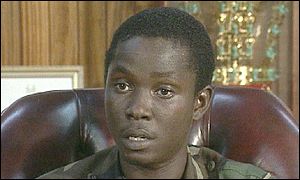 (Photo swiped from the BBC.)
Born in 1967, he was a junior military officer in Sierra Leone until a group of his friends almost inadvertently overthrew Joseph Saidu Momoh, and installed him as leader in 1992, when he was only 25. (Too young, as it turns out, to constitutionally run for re-election.) He seemed pretty ineffectual as a leader. He was an unremarkable African dictator. Unable to defeat or make peace with the former corporal Foday Sankoh's Revolutionary United Front, Strasser hired South African mercenary firm Executive Outcomes to do the job for him. Executive Outcome quickly incited a counterrevolution, and proceeded to "loot[] and burn[] their way through RUF territory."
Strasser was overthrown in 1996 by Julius Maada Bio in a bloodless coup, and wound up, at the age of 29, going to school in Warwick, England, under the auspices of the UN (which, apparently, gave him a one-year scholarship). He attended more clubs than classes, though, and, at one point, claimed he was assaulted in an alleged racial incident.
He currently lives with his mother in Sierra Leone, where the government had to urge people to stop making fun of him and throwing rocks at him. Last year, resurfaced as head of the People's Redemption Party in a bid to run for President (now that he was old enough to under the constitution). He didn't win.
There's a novel or a short story in here somewhere.
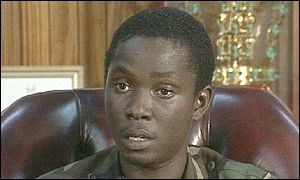 (Photo swiped from the BBC.)
 Born in 1967, he was a junior military officer in Sierra Leone until a group of his friends almost inadvertently overthrew Joseph Saidu Momoh, and installed him as leader in 1992, when he was only 25. (Too young, as it turns out, to constitutionally run for re-election.) He seemed pretty ineffectual as a leader. He was an unremarkable African dictator. Unable to defeat or make peace with the former corporal Foday Sankoh's Revolutionary United Front, Strasser hired South African mercenary firm Executive Outcomes to do the job for him. Executive Outcome quickly incited a counterrevolution, and proceeded to "loot[] and burn[] their way through RUF territory."
Strasser was overthrown in 1996 by Julius Maada Bio in a bloodless coup, and wound up, at the age of 29, going to school in Warwick, England, under the auspices of the UN (which, apparently, gave him a one-year scholarship). He attended more clubs than classes, though, and, at one point, claimed he was assaulted in an alleged racial incident.
He currently lives with his mother in Sierra Leone, where the government had to urge people to stop making fun of him and throwing rocks at him. Last year, resurfaced as head of the People's Redemption Party in a bid to run for President (now that he was old enough to under the constitution). He didn't win.
There's a novel or a short story in here somewhere.
Thursday, March 23, 2006
Historical Characters: Michael Scott, The Pope's Merlin
Today's Scotsman.com (and don't ask why I was reading that ...) has an article on Michael Scott, a thirteenth-century Scottish magician (and Oxford graduate) who served as court astrologer for Holy Roman Emperor Frederick II (last seen fictionally in Umberto Eco's Baudolino), and as an advisor to Popes Honorius III and Gregory IX. (Not as unusual as it sounds -- Popes at that time frequently subscribed to astrology.)
In addition to various magic acts that were ascribed to him (including changing the course of the river Tweed and foreseeing his own death following an accident with falling masonry), Scott also translated a number of Arbaic books into Latin.
He has since been immortalized in Dante's Inferno, as well as in Sir Walter Scott's (likely no relation) Lay of the Last Minstrel, and, oddly enough, a British children's television series.
In addition to various magic acts that were ascribed to him (including changing the course of the river Tweed and foreseeing his own death following an accident with falling masonry), Scott also translated a number of Arbaic books into Latin.
He has since been immortalized in Dante's Inferno, as well as in Sir Walter Scott's (likely no relation) Lay of the Last Minstrel, and, oddly enough, a British children's television series.
Wednesday, March 22, 2006
Wilderness Justice
Went for a quick hike at Great Falls, Maryland this week, and ran across a plaque commemorating how the park became a park. Usually, these are pretty dry affairs, but it turns out that the story behind this one involved a Supreme Court Justice -- Douglas -- responding to Washington Post editorial by challenging the reporters to hike the old C&O canal path with him. 189 miles of wilderness, handled by a bunch of Washington lawers and reporters. There's a novel in there somewhere, most likely something comic.
Link to some primary source excerpts.
Link to the National Park Service account, which includes a fourteen-stanza poem commemorating the hike. Awful poetry, but gives a good idea of the route traveled and the complaints lodged.
Link to some primary source excerpts.
Link to the National Park Service account, which includes a fourteen-stanza poem commemorating the hike. Awful poetry, but gives a good idea of the route traveled and the complaints lodged.
Tuesday, March 21, 2006
Last Bit of Da Vinci Trial
Oh what a difference a closing argument makes. The lawyers for Holy Blood, Holy Grail are making a pretty sweeping argument for copyright. At least, from the newspaper summary.
So, in other words, you can't use a book that synthesizes the history you're researching for a novel because it will save you time and effort, and that's bad? That's just a bad argument.
"Brown has used 'H.B.H.G.' with the intention of appropriating the work of its authors," Mr. Rayner James said. "He and/or Blythe has intentionally used 'H.B.H.G.' in order to save the time and effort that independent research would have required."
Friday, March 17, 2006
Ancient Nubia
The University of Chicago's Oriental Institute has opened a new exhibition on ancient Nubia. (Not redundant -- there were approximately eight distinct historical epochs for the region, starting with what archaeologists call the A-Group and leading up through a Christianized period that lasted from circa AD 550-1400.)
More on ancient African civilizations:
Freeman Institute's chronology.
University of Pennsylvania's collection.
Oriental Institute's 1992 exhibition brochure.
More on ancient African civilizations:
Freeman Institute's chronology.
University of Pennsylvania's collection.
Oriental Institute's 1992 exhibition brochure.
Thursday, March 16, 2006
What the Hell is Reworking?
Today's Times has an article about the Dan Brown trial in the UK. (Disclosure: I still haven't read The Da Vinci Code all the way through. After two attempts, I just couldn't get past the leaden prose.) Before the trial started, I had assumed that the trial was just proof that Brown had gotten rich and famous enough to draw lawsuits. It happens. But the lede bothers me:
Brown's former publisher apparently defended the book by calling it a "romping piece of good fiction," which sounds more like ad copy than a cogent response. ("You reworked my passages!" "Yes, but now they romp.")
Next entry: something not from the New York Times Books section.
On his third day of testimony in a London court yesterday, Dan Brown acknowledged "reworking" passages from another book for his best-selling novel "The Da Vinci Code," but rejected charges that he stole key ideas for his thriller ...The word is stripped of all meaningful context, but "reworking," to me, sounds like someone took a nonfiction passage, wrote it down, and then, instead of treating it as research notes, revised it until it fit into their work. "Drew on," "relied on," "read," all stuff I could see an author doing while researching something. But "reworked," that sounds like it's getting dangerously close to plagiarism.
Brown's former publisher apparently defended the book by calling it a "romping piece of good fiction," which sounds more like ad copy than a cogent response. ("You reworked my passages!" "Yes, but now they romp.")
Next entry: something not from the New York Times Books section.
Wednesday, March 15, 2006
Paging Detective Crosetti ...
I have to admit, I've walked by Manhunt about ten times in the bookstore, and never thought to pick it up. Probably because every time I saw the book, I would think of ill-fated Detective Steve Crosetti from the late, lamented series Homicide. He spent the entire first two seasons bothering his partner with his pet theories about who really killed Lincoln. It was a nice touch for a homicide detective character, and I remember thinking it was a smart parody of many people's obsession with the Kennedy assassination.
This article in today's New York Times makes Swanson sound like a real-life Crosetti. Not that he's a conspiracy theorist. Just that he's got that monomaniacal touch that makes people interesting to read about. His fixation started early:
This article in today's New York Times makes Swanson sound like a real-life Crosetti. Not that he's a conspiracy theorist. Just that he's got that monomaniacal touch that makes people interesting to read about. His fixation started early:
Mr. Swanson owns all four of the known wanted posters advertising $100,000 rewards for the capture of Booth and his co-conspirators. He bought the first for $2,000 when he was 19, with money he saved working at a Chicago can manufacturing plant throughout high school. "Some people saved their money to buy a car; I wanted the reward poster," Mr. Swanson said.And there's no question it continued on through his writing.
During the three years that it took him to write the book, Mr. Swanson said he all but imprisoned himself in his house. He listened only to Civil War-era music and read original documents from the time. He purchased a full run of The Chicago Tribune from April through July 1865 as well as originals of The New York Herald, spreading the papers over the length of his 14-foot dining room table to study every detail, for days at a time. ... For breaks from his isolation, Mr. Swanson would clear out his papers and give impromptu parties to reconnect with his high-powered friends in the outside world — and, no doubt, to generate interest in his project.
At this point, I'm tempted to pick up the book. I could still take or leave the subject matter, but I would love to get inside his head and see what kept him so interested in those twelve days.
"When I [Univeristy of Chicago Professor John Hope Franklin] read the book I smiled and said, 'There is James.' "Yeah, that.
Tuesday, March 14, 2006
Dime Store History
OK, this is the first post, so we'll make it short and sweet.
Hello, and welcome to Dime Store History. I'm a sucker for good stories, so much so that I took some serious time off from my day job to try and make a go at writing a historical novel. (It's going, great, thanks for asking. Just peachy. Rewriting Chapter 10 isn't giving me fits at all.) Sometimes I'll focus on history, sometimes on fiction, sometimes, when it's really good, on both.
Mostly, this is a research dump for me, so I can keep all of my story ideas and other random stuff for my writing in one place. It's also, hopefully, a way to keep me writing daily, and unfreeze that part of my brain that locks up when I realize I might have to put some of this writing in front of an audience. Write-for-hire stuff? No problem. That I get where it's supposed to go as soon as the deadline arrives. But the stuff that just amuses me? I could sit on it for years.
I have no idea where this will go, but hopefully, it'll be an interesting ride. So come along, and buckle up. And if you see the turn I'm supposed to be taking, sing out.
Hello, and welcome to Dime Store History. I'm a sucker for good stories, so much so that I took some serious time off from my day job to try and make a go at writing a historical novel. (It's going, great, thanks for asking. Just peachy. Rewriting Chapter 10 isn't giving me fits at all.) Sometimes I'll focus on history, sometimes on fiction, sometimes, when it's really good, on both.
Mostly, this is a research dump for me, so I can keep all of my story ideas and other random stuff for my writing in one place. It's also, hopefully, a way to keep me writing daily, and unfreeze that part of my brain that locks up when I realize I might have to put some of this writing in front of an audience. Write-for-hire stuff? No problem. That I get where it's supposed to go as soon as the deadline arrives. But the stuff that just amuses me? I could sit on it for years.
I have no idea where this will go, but hopefully, it'll be an interesting ride. So come along, and buckle up. And if you see the turn I'm supposed to be taking, sing out.
Subscribe to:
Posts (Atom)
