The beginning and end of this article are too cute by half, but the general idea -- that time is just another tool in fiction writing, and that certain genres handle it better than others because of the expectations people have of them -- well, that bears some further thinking.
(There'll be more about Life on Mars at some point. Great show.)
Sunday, August 20, 2006


Sundays at Border - 20 August 2006 - Welcome Ego Surfers! Edition
I've noticed that most of the very few hits on this blog come from Google, Technorati, and Feedster searches for author names, and it seems to be a different name each time. Now, it could be that some first-time authors have already generated enough buzz that people are searching out what they can on them. But it seems a safer bet that this kind of one-to-a-customer search is coming from nervous authors checking on their newborns. For which I have a great deal of sympathy.
So here's the deal. This particular weekly entry is just my way of getting a feel for what's in the market. The stuff that looks good, I'll likely buy and read. The others, probably not. But if I didn't think your book looked good, and you want to change my mind, feel free to get in touch with me.
So, my quick takes the new-and-reviewed:
History
There Goes My Everything: White Southerners in the Age of Civil Rights, 1945-1975, by Jason Sokol, reviewed by Jonathan Yardley in the Washington Post. Here's the part that everyone will be talking about: "[i]t's difficult not to approach Sokol's book with sheer astonishment that it has been written by one so young." Here's the part that makes me want to pick it up: "he has read a huge amount of material ignored by others -- the personal testimony of whites whose lives were changed by the movement -- and his account of what happened to them is sound and perceptive."
Two Elvis Books - Fortunate Son: The Life of Elvis Presley, by Charles L. Ponce de Leon and Me and a Guy Named Elvis: My Lifelong Friendship with Elvis Presley, by Jerry Schilling with Chuck Crisafulli, both reviewed by Joe Heim in the Washington Post. Fortunate Son reads like "an overlong Wikipedia entry" -- yeowch. On the other hand, it looks like Schilling and Crisafulli have shown us an Elvis that could have fronted Entourage, which is at least a fresh take.
James Tiptree, Jr.: The Double Life of Alice B. Sheldon, by Julie Phillips, reviewed by Dave Itzkoff in the New York Times. Itzkoff calls it a "thoughtful and meticulous biography." And the description of a woman caught up in an increasingly complicated pseudonym sounds more compelling each time I read about it. (The Times has the first chapter up, and, kludgy present-tense intro paragraphs aside, it reads well.)
LBJ: Architect of American Ambition, by Randall B. Woods, reviewed by Alan Brinkley in the New York Times. Good Lord, another LBJ Biography? Maybe -- according to Brinkley, "Woods has produced an excellent biography that fully deserves a place alongside the best of the Johnson studies yet to appear." (First chapter is up, and it looks like Woods is trying some fictional techniques in his biographing.)
Dead Man in Paradise, by James MacKinnon, reviewed by Ian Thomson in the Independent. A "true-crime thriller" investigating the murder of a Jesuit priest in the post-Trujillo Dominican Republic. The possibility of purple prose worries me a little, but the period is fascinating, and Thomson thinks the language problems are just "hiccups in a superb work of reportage."
Iron Kingdom, by Christopher Clark, reviewed by Brendan Simms in the Independent. A history of Prussia, or, as Simms calls it "a sophisticated yet accessible acocunt of how a middling German dynasty manoeuvred its way into the European pentarchy of powers." Which is really just a hiccup in an interesting review of a book that I'd be a sucker for anyway.
Historical Fiction
The Three Musketeers, by Alexandre Dumas, translated with an introduction by Richard Pevear, reviewed by Terrence Rafferty in the New York Times. Yes, Dumas wrote historical fiction -- he lived in the 19th century, and provided "long, scenic excursions into French history ... for the newspaper readers of mid-19th-century Paris." Rafferty thinks he was a "hack with genius," and that Pevear's translation brings out his "pure nuttiness," which sells me, frankly.
So here's the deal. This particular weekly entry is just my way of getting a feel for what's in the market. The stuff that looks good, I'll likely buy and read. The others, probably not. But if I didn't think your book looked good, and you want to change my mind, feel free to get in touch with me.
So, my quick takes the new-and-reviewed:
History
There Goes My Everything: White Southerners in the Age of Civil Rights, 1945-1975, by Jason Sokol, reviewed by Jonathan Yardley in the Washington Post. Here's the part that everyone will be talking about: "[i]t's difficult not to approach Sokol's book with sheer astonishment that it has been written by one so young." Here's the part that makes me want to pick it up: "he has read a huge amount of material ignored by others -- the personal testimony of whites whose lives were changed by the movement -- and his account of what happened to them is sound and perceptive."
Two Elvis Books - Fortunate Son: The Life of Elvis Presley, by Charles L. Ponce de Leon and Me and a Guy Named Elvis: My Lifelong Friendship with Elvis Presley, by Jerry Schilling with Chuck Crisafulli, both reviewed by Joe Heim in the Washington Post. Fortunate Son reads like "an overlong Wikipedia entry" -- yeowch. On the other hand, it looks like Schilling and Crisafulli have shown us an Elvis that could have fronted Entourage, which is at least a fresh take.
James Tiptree, Jr.: The Double Life of Alice B. Sheldon, by Julie Phillips, reviewed by Dave Itzkoff in the New York Times. Itzkoff calls it a "thoughtful and meticulous biography." And the description of a woman caught up in an increasingly complicated pseudonym sounds more compelling each time I read about it. (The Times has the first chapter up, and, kludgy present-tense intro paragraphs aside, it reads well.)
LBJ: Architect of American Ambition, by Randall B. Woods, reviewed by Alan Brinkley in the New York Times. Good Lord, another LBJ Biography? Maybe -- according to Brinkley, "Woods has produced an excellent biography that fully deserves a place alongside the best of the Johnson studies yet to appear." (First chapter is up, and it looks like Woods is trying some fictional techniques in his biographing.)
Dead Man in Paradise, by James MacKinnon, reviewed by Ian Thomson in the Independent. A "true-crime thriller" investigating the murder of a Jesuit priest in the post-Trujillo Dominican Republic. The possibility of purple prose worries me a little, but the period is fascinating, and Thomson thinks the language problems are just "hiccups in a superb work of reportage."
Iron Kingdom, by Christopher Clark, reviewed by Brendan Simms in the Independent. A history of Prussia, or, as Simms calls it "a sophisticated yet accessible acocunt of how a middling German dynasty manoeuvred its way into the European pentarchy of powers." Which is really just a hiccup in an interesting review of a book that I'd be a sucker for anyway.
Historical Fiction
The Three Musketeers, by Alexandre Dumas, translated with an introduction by Richard Pevear, reviewed by Terrence Rafferty in the New York Times. Yes, Dumas wrote historical fiction -- he lived in the 19th century, and provided "long, scenic excursions into French history ... for the newspaper readers of mid-19th-century Paris." Rafferty thinks he was a "hack with genius," and that Pevear's translation brings out his "pure nuttiness," which sells me, frankly.
Saturday, August 19, 2006
Yeah, What About All Those Norse Myths?
From The Independent, a few days back (but only just noticed this AM). Bernardine Evaristo makes some valid complaints about stale poetry:
The published poetry scene actually needs an injection of alternative histories, cultures and stories. Haven't we had enough of the same old same old: my childhood memories; my mildly dysfunctional parents; my repressed grandparents; Greek myths; my last lover; my new lover; my love of nature; more Greek myths; my holidays in foreign lands.(Emphasis added for, well, emphasis.) Two reactions:
- She's got a point. I'd love to see more exploration of other histories and myths that doesn't just sound like "my holidays in foreign lands."
- Poetry. Another form of historical fiction. You know, like Beowulf, and the Iliad? Lots of room on this bookshelf.
Friday, August 18, 2006
Some More History and Film
Haven't had the chance to see The Illusionist, but Dana Stevens at Slate gives it a good review. Giamatti, Sewell, Norton. That's enough for me. But most notably, for purposes of this blog:
The Illusionist also has considerable intellectual ambitions, though it tucks them discreetly up its sleeve. The film shows the competing strains of spiritualism and scientific rationalism that dominated late-19th-century thought, while the figure of the prince is an odd mix of modern ideas and imperial aspirations: He wants to overthrow his dictatorial father so he can rule more democratically.I'm looking forward to seeing this. (So's the fiancee, but she's really excited about Snakes on a Plane.)
History and Film: Red River
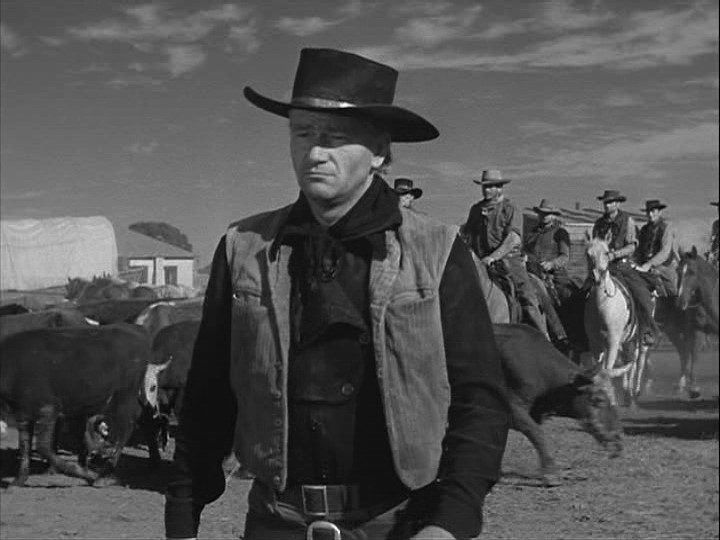
It's Friday, so it's time to hit the multiplex. And since Red River was sitting on my TiVo, waiting to be watched, why not go with that? Quick thoughts (because real analysis requires work):
- Tom Dunson (John Wayne) the cattle baron gets set up from the beginning as less-than-sympathetic. He deserts a wagon train (leaving his girl to die). He takes land from Don Diego. And he tries to steal a fellow cattle baron's cattle, only confessing to it when he’s almost caught. Hardly a movie that mindlessly glorifies pioneers.
- For the first forty-five minutes, there’s a nice discussion of the economic forces that lead to the drive up the Chisolm trail waeved into the dialogue. It doesn’t feel like forced exposition -- it’s front-and-center for these guys because it would be. Of course, it doesn’t hurt that Matt Garth(Dunson's foster son, played by Montgomery Clift) was “away,” for most of the fourteen years, allowing everyone to catch him up on what happened while he was gone.
- And that's one one of those things you don’t often deal with in non-historical fiction. Economic discussions. (It’s not unheard of, but it doesn’t always have the same urgency to the plot as in these kinds of stories.)
- The voiceover/montage at the beginning feels a little kludgy to this modern eye (ear? some kind of facial orifice), but it does get you through fourteen years in the space of a minute or so. (This kind of technique is something I want to study harder. How do you handle large swathes of time?)
- The whipping scene – nice way to show how hard discipline is outside of civilization. The fact that it's followed by desertions and outright mutiny shows a nice thinking through of the consquences of these actions. Tom Dunson, not too far off from Captain Bligh. (Apparently, I'm not the only one to notice this.)
- The journal-page-as-title-page trick, while not unique, is a decent way of making the movie "feel" historical. At least, it was in 1948, before it got overdone. Why does it work here, when I'd usually roll my eyes at it?
- Unfortunately, the negotiation in the denoument is unrealistic compared to discussion of everyone's dire economic straits in the beginning. It’s a little too convenient. It doesn't wreck the film because it’s incidental to the main theme of the story, which is the struggle between Garth and Dunson, but it can still creep past suspension of disbelief.
- After the Winslow Boy commentary, I've been trying to watch props a little more. Three key ones that bear watching through the film (aside from the handwritten journal pages) are the bracelet, Garth's gun, and the brands for the cattle.
- And there's a definite homoerotic subtext. I'm certainly not the first to notice this. Just sayin’ is all.
Thursday, August 17, 2006
Aprocrypha
Been a real long day, so just a few random notes:
- Professor David Mould asks if there's "Too Much Lewis and Clark in History?" Actually, he just goes over their route (again), but the title is catchy.
- So, suppose you want to go to a bookstore to fill in an embarrassing gap in your reading by getting a copy of Nobel Laureate Toni Morrison's much-lauded historical ghost story Beloved. Let's say that the bookstore in question has decided not to shelve the title (or the author) in Fiction/Literature. Where else do you look? Horror? History? A special shelf for Nobel Laureates in Literature? (And seriously, shouldn't we have one of those?) Nope. African-American literature. Because, you know, Nobel Laureate Toni Morrison's single defining characteristic? African-American.
- Sounds like this may not be a good book, but the review is fascinating.
Wednesday, August 16, 2006
Graphic History: The Death of Thomas Scott
This is part of a longer work I've been meaning to pick up -- Louis Riel: A Comic Strip Biography, by Chester Brown. The excerpt appeared in McSweeny's Quarterly Concern No. 13.

Just a few notes --
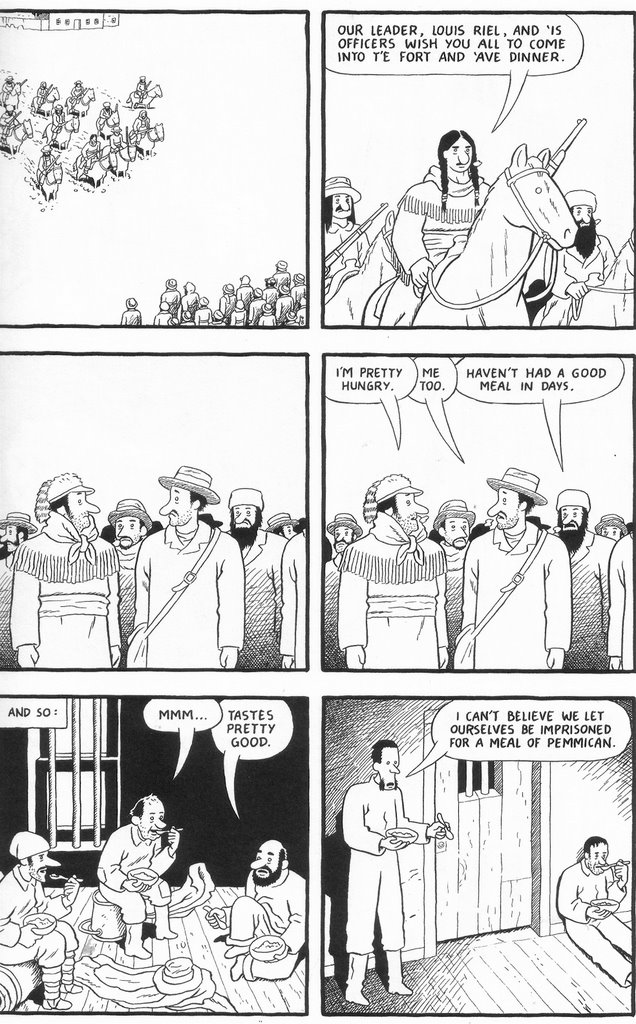
Just a few notes --
- Riel was an important figure in Manitoban history -- the death of Thomas Scott resulted in his exile, which, in turn, led to an almost Messianic belief that he had to lead his people (the Metis) people in revolt aganist the Canadian government.
- Brown, on his inspiration (from an interview with Time.com):
I was looking to do something non-fiction because I had done a strip, "My Mom Was a Schizophrenic" [which examined the historical diagnosis of schizophrenia and those who disagree with its classification as a disease.] I really enjoyed the process of doing that strip, despite its subject matter. To do it I'd had to do a lot of research and reading and I figured I'd like to do that again. Also, in the last couple of years I've had an interest in history and politics. I was reading various historical books and I read Maggie Siggin's Louis Riel biography ["Riel: A Life of Revolution"] and it seemed like a good, dramatic story that would translate well into comic-strip form.
- A constant problem when recreating historical events is how to treat action and dialogue. Do you make it as painstakingly accurate as possible, leading to awkward storytelling? Or do you gussy it up because, hey, no one knows what really happened? Brown's deadpan dialogue (pictured above) is an elegant solution.
- I think it also goes hand-in-hand with the cartoony art style. Not a lot of ornament or fuss. Here's the facts as we known them. Have fun.
Tuesday, August 15, 2006
Primary Sources ...
This one's more for my own reference than anything else. New book out in New Zealand, which takes a historical view of a number of obscure (even for New Zealand) Kiwi authors. As the reviewer puts it:
Aesthetic evaluations and obsessive fussing over rankings within the literary canon have given way to a readiness to accept literature as a branch of social history, furnishing documents that can be examined as evidence of bygone attitudes.For the new sociologically minded approach, the writing analysed does not need to be brilliant. Indeed, brilliance rather gets in the way. The more commonplace - and thus representative - the attitudes expressed the better ...
But still we have the oddity of a work of literary criticism that tackles literature hardly anyone, apart from Stafford and Williams, has read.
I've mostly been focusing on how history informs fiction. But the relationship is a two-way street.
Monday, August 14, 2006
Walesa calls out Grass
Now this, I don't even know what to say about this. It's like watching Mom and Dad fight, if both of them were men, and Nobel laureates, and one of them an illicit affair with the racist down the street twenty years ago and decided to mention it one night over the sausage and potatoes and got told to pack his bags. (And, you know, he was about to write a book about it.) Which, I have to admit, is more screwed up than my family ever got.
Given Sucking
Tim Willock's new novel (that of the "historical dialogue" mentioned last week), The Religion, gets reviewed in the Independent. It sounds about as bad as I feared:
When not slaking his lusts, Willocks contents himself with mounting an assault on the English language that puts the Ottoman hordes to shame. The narrative voice in The Religion is prevailingly that of the pulp historical romance - babes are "given suck", people wave "damask blades", women "sashay", men "swive" - but it can occasionally rise to the kind of Basic English that Kingsley Amis used to write as a joke, especially when speaking of the great imponderables of manhood and existence. "This was what it was to be a man," intones Willocks, "this, and not some thing other than this."I told thee so.
Sunday, August 13, 2006
Sunday at Borders - 13 August 2006
New and reviewed this week in history and historical fiction:
History
Building Houses Out of Chicken Legs: Black Women, Food, and Power, by Psyche A. Williams-Forson, reviewed by Matt Lee and Ted Lee in the New York Times. Sounds like intriguing social history. What can we learn about a disenfranchised population from how they interacted with food?
The Parliament of Man: The Past, Present, and Future of the United Nations, by Paul Kennedy, reviewed by James Traub in the New York Times. One of the grand old men of the history of great-power politics takes on the UN. Probably not much new in it, but who reads Paul Kennedy to find something new?
Historical Fiction
The Judas Field: A Novel of the Civil War, by Howard Bahr, reviewed by Jeffrey Lent in the Washington Post. Yet another Civil War novel. But at least this one's about a lesser-known battle (Franklin, Tennessee), and looks like it may have an actual story in it.
The Glass Books of the Dream Eaters, by Gordon Dahlquist, reviewed by Kevin Allman in the Washington Post. Sometimes, no matter how wrong it is, it's fun to review a book by its title -- and why would anyone use both "Glass Books" and "Dream Eaters?" Allman's full review doesn't dissuade me ("poonderously ornate").
Helen of Troy, by Margaret George, reviewed by Clare Clark in the Washington Post. A woman's-eye view of the events in the Iliad, but without the gods, apparently. Too bad, they do a lot to explain why Helen wasn't completely nuts.
The Book About Blanche and Marie, by Per Olov Enquist, reviewed by Ruth Franklin in the Washington Post. Blanche Witman was Marie Curie's lab assistant, and later the subject of some ghastly medical experiments, and, in this book, she sleeps with her neurologist, too. Sounds like the Marie Curie parts may be interesting, though.
History
Building Houses Out of Chicken Legs: Black Women, Food, and Power, by Psyche A. Williams-Forson, reviewed by Matt Lee and Ted Lee in the New York Times. Sounds like intriguing social history. What can we learn about a disenfranchised population from how they interacted with food?
The Parliament of Man: The Past, Present, and Future of the United Nations, by Paul Kennedy, reviewed by James Traub in the New York Times. One of the grand old men of the history of great-power politics takes on the UN. Probably not much new in it, but who reads Paul Kennedy to find something new?
Historical Fiction
The Judas Field: A Novel of the Civil War, by Howard Bahr, reviewed by Jeffrey Lent in the Washington Post. Yet another Civil War novel. But at least this one's about a lesser-known battle (Franklin, Tennessee), and looks like it may have an actual story in it.
The Glass Books of the Dream Eaters, by Gordon Dahlquist, reviewed by Kevin Allman in the Washington Post. Sometimes, no matter how wrong it is, it's fun to review a book by its title -- and why would anyone use both "Glass Books" and "Dream Eaters?" Allman's full review doesn't dissuade me ("poonderously ornate").
Helen of Troy, by Margaret George, reviewed by Clare Clark in the Washington Post. A woman's-eye view of the events in the Iliad, but without the gods, apparently. Too bad, they do a lot to explain why Helen wasn't completely nuts.
The Book About Blanche and Marie, by Per Olov Enquist, reviewed by Ruth Franklin in the Washington Post. Blanche Witman was Marie Curie's lab assistant, and later the subject of some ghastly medical experiments, and, in this book, she sleeps with her neurologist, too. Sounds like the Marie Curie parts may be interesting, though.
Thursday, August 10, 2006
Some Quick Links
* Jane Robbins makes Rebel Queen Caroline of Brunswick (tried for adultery in 1820) sound like the kind of woman you'd want to meet at a party -- provided it's not at your house.
* 514 years later, Christopher Columbus continues to make Dead White Men look bad, "cutting off people's ears and noses, parading women naked through the streets and selling them into slavery."
* And, new and reviewed historical fiction in Publisher's Weekly:
On being introduced to gauche and garrulous Caroline three days before the nuptials, [George IV] looked ill and requested brandy. She, with her customary tactlessness, commented on his bulk. Nine months later, their daughter Charlotte was born.
* 514 years later, Christopher Columbus continues to make Dead White Men look bad, "cutting off people's ears and noses, parading women naked through the streets and selling them into slavery."
* And, new and reviewed historical fiction in Publisher's Weekly:
- The Boleyn Inheritance, by Phillipa Gregory -- Apparently, it's time for the story of the other Other Boleyn Girl.
- Unconfessed, by Yvette Chistianse -- The premise, following a slave in a South African prison who murdered her son, hits right in the solar plexus, but I'm a little suspicious of any nook that "alternates between exhausted lament, seething rage and scripture-tinged poetic soliloquy."
- The Rising Tide: A Novel of the Second World War, by Jeff Shaara -- The subtitle is useful, since it tells us Robert E. Lee will not be making an appearance.
- A Dangerous Love, by Bertrice Small -- Part one of an "action-packed erotic tale set in the English and Scottish borderlands just before and during the Tudor period." I have to admit, it's the combination of the pulpy ("action packed erotic") and precise ("just before and during the Tudor period") that makes me want to pick this up.
- The Last Van Gogh, by Alyson Richman -- Doctor's daughter sleeps with earless artist.
- A Fine Crack of Light, by Pam Jenoff -- Billed as a "historical romance," but the plot, Polish Jew spies on, and maybe falls for, Nazi Commandant, sounds intriguing.
- The Tailor's Daughter, by Janice Graham -- "How much can one middle-class Victorian-era woman endure?" You know, I'm okay staying in the dark on this one.
Wednesday, August 09, 2006
Graphic History: The Plot
It's Wednesday, which means that it's time for another installment of Graphic History -- historical fiction in the comics.

This week, we look at Will Eisner's last work, The Plot: The Secret Story of The Protocols of the Elders of Zion. Produced over the course of twenty years, this is Eisner's attempt to sum up the various research debunking one of the most persistent anti-Semitic tracts in modern history. Just a few quick things to note:
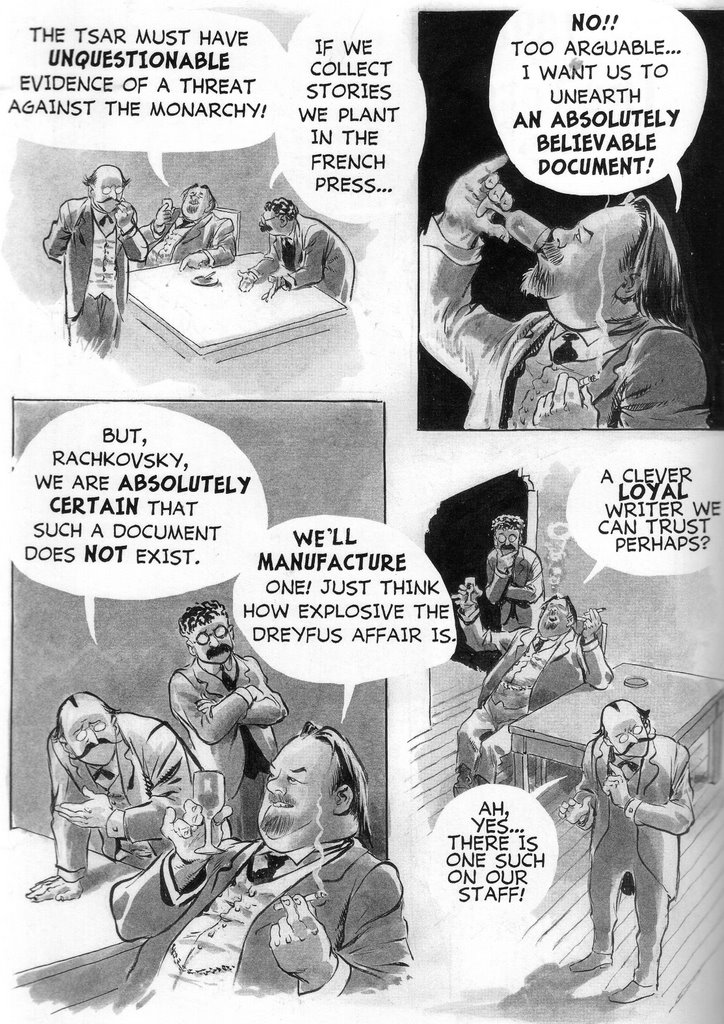
This week, we look at Will Eisner's last work, The Plot: The Secret Story of The Protocols of the Elders of Zion. Produced over the course of twenty years, this is Eisner's attempt to sum up the various research debunking one of the most persistent anti-Semitic tracts in modern history. Just a few quick things to note:
- The history is impeccable, the fiction not quite as much. Primarily because Eisner seems more interested in making his argument than in creating three-dimensional characters. This is hardly a flaw in the overall work -- The Plot succeeds because it uses the techniques of graphic fiction (dramatizing scenes, laying facsimiles of text side-by-side with commentary) to make an otherwise complicated explanation much simpler. But the narrative "thrust" of the book -- which seems to ask when we'll see the end of the Protocols (answer: no time soon) -- makes for a weakish ending.
- Using Philip Graves -- a British reporter who wrote a series of articles on the Protocols -- as a central character is an smart tactic (and aging him throughout the remainder of the story is a nice touch). Am I the only one who thinks that he winds up looking a little like Eisner's old Commissioner Dolan by the end?
- It's interesting that Eisner engages in some of the same tactics as the Protocols themselves, putting words in the mouths of historical figures. It doesn't detract from his argument (argumentive dialogues are an old, honored technique), but it does set up a few resonances.
Tuesday, August 08, 2006
HistFic Follies: Dialogue
From an article in last week's Independent flogging Tim Willocks's latest:
Yes, there is no question that historical fiction allows you to get flowery with language. David Milch has been doing it on TV with the excellent Deadwood, and writers as good and diverse as William Shakespeare (Henry V) and Atturo Perez Reverte (The Fencing Master) have been doing it on the stage and the page. But other writers, like Umberto Eco (The Name of the Rose) and Neal Stephenson (Quicksilver) have done well with blunter or simpler dialogue in historical fiction. And Thomas Pynchon (The Crying of Lot 49) and Peter Carey (My Life as a Fake) have certain shown that you can use ornate, or "flowerly," dialogue to great effect in fiction with a modern setting.
I'm going to come back to this one a lot, but I thought I'd get it out there as soon as possible. Historical dialogue does not have to be flowery. Not if it's accurate, and not if it's designed to let you know that something happened in the past. There are valid reasons to make dialogue -- past or present -- either blunt or ornate. But writing flowery dialogue for no other reason than to make it sound "historical" is misinformed and lazy.
It was very freeing to work in a different time, to work with language in a different way. Modern dialogue is a bit stunted - it has to be. It's nice with historical fiction to be a little more flowery.Now, I know it's unfair to grab a soundbite from an interview that really exists only sell the author's latest and then rant and rave against it, but this is one of those constantly repeated truths about historical fiction that drastically oversimplifies what the genre (to the extent that it is a genre) can do.
Yes, there is no question that historical fiction allows you to get flowery with language. David Milch has been doing it on TV with the excellent Deadwood, and writers as good and diverse as William Shakespeare (Henry V) and Atturo Perez Reverte (The Fencing Master) have been doing it on the stage and the page. But other writers, like Umberto Eco (The Name of the Rose) and Neal Stephenson (Quicksilver) have done well with blunter or simpler dialogue in historical fiction. And Thomas Pynchon (The Crying of Lot 49) and Peter Carey (My Life as a Fake) have certain shown that you can use ornate, or "flowerly," dialogue to great effect in fiction with a modern setting.
I'm going to come back to this one a lot, but I thought I'd get it out there as soon as possible. Historical dialogue does not have to be flowery. Not if it's accurate, and not if it's designed to let you know that something happened in the past. There are valid reasons to make dialogue -- past or present -- either blunt or ornate. But writing flowery dialogue for no other reason than to make it sound "historical" is misinformed and lazy.
Monday, August 07, 2006
Playing History
From yesterday's New York Times, an article by Ed Leibowitz on actors who play historical figures.
Leibowitz focuses mostly on physical resemblance and voice pattern, but it's a larger question for historical fiction, and one that no doubt will recur. (And make no mistake, biopics are historical fiction. They dramatize rather than report.) How true do you stay to people who really existed? Do you report details faithfully, or change those things you need to to make a story more interesting? Do you glamorize your lead character, or try to make them seem as real as possible? And which of those requires the most invention?
Leibowitz focuses mostly on physical resemblance and voice pattern, but it's a larger question for historical fiction, and one that no doubt will recur. (And make no mistake, biopics are historical fiction. They dramatize rather than report.) How true do you stay to people who really existed? Do you report details faithfully, or change those things you need to to make a story more interesting? Do you glamorize your lead character, or try to make them seem as real as possible? And which of those requires the most invention?
Sunday, August 06, 2006
Sunday at Borders: 6 August 2004
Linkblogging the new and reviewed in history and historical fiction this week:
History
Richard Hofstadter: An Intellectual Biography, by David S. Brown, reviewed by Sam Tanenhaus. Hofstadter is best-known to generations of college students for his often-assigned work The American Political Tradition. Brown's biography delves much deeper, tracing Hofstadter's early trust in, and later disillusionment from, popular politics in history.
James Tiptree Jr.: The Double Life of Alice B. Sheldon, by Julie Phillips, reviewed by Martin Morse Wooster. Science fiction has traditionally been a male-dominated field. Phillips's book follows a woman who decided the best way to break in was to publish as a man.
And Yardley's latest -- Jonathan Yardley takes on the slim memoir of George Appo, which gives a revealing look at post-Civil-War crime in New York City.
Historical Fiction
An Iliad, by Allesandro Baricco, reviewed by Nick Tosches. Baricco thinks that his "translation of a translation" would make postmodernism's granddaddy Borges proud. Tosches, with great regret, disagrees.
The Syringa Tree, by Pamela Gien, reviewed by Wendy Kann. Apartheid is now, thankfully, history. And Gien's novel apparently recasts To Kill a Mockingbird there.
History
Richard Hofstadter: An Intellectual Biography, by David S. Brown, reviewed by Sam Tanenhaus. Hofstadter is best-known to generations of college students for his often-assigned work The American Political Tradition. Brown's biography delves much deeper, tracing Hofstadter's early trust in, and later disillusionment from, popular politics in history.
James Tiptree Jr.: The Double Life of Alice B. Sheldon, by Julie Phillips, reviewed by Martin Morse Wooster. Science fiction has traditionally been a male-dominated field. Phillips's book follows a woman who decided the best way to break in was to publish as a man.
And Yardley's latest -- Jonathan Yardley takes on the slim memoir of George Appo, which gives a revealing look at post-Civil-War crime in New York City.
Historical Fiction
An Iliad, by Allesandro Baricco, reviewed by Nick Tosches. Baricco thinks that his "translation of a translation" would make postmodernism's granddaddy Borges proud. Tosches, with great regret, disagrees.
The Syringa Tree, by Pamela Gien, reviewed by Wendy Kann. Apartheid is now, thankfully, history. And Gien's novel apparently recasts To Kill a Mockingbird there.
History and Film: The Winslow Boy
Another thing that I hope to do regularly on Fridays. Which means, of course, that I'm off to a great start.
For a writer/director known for his very modern, highly stylized verbal tics, David Mamet offers up two surprises in this adaptation of Terrence Mattigan's stage play. First, with the exception of a couple of additional lines (including, apparently, the "how little you know" exchange at the end), he holds to Mattigan's original script pretty tightly.
Second, and more interesting, he relies heavily on props to tell his story (a fact that comes through clearly on his DVD commentary). While the characters aren't above relating exposition to each other, Mamet repeatedly refers to handwriting samples, editorial cartoons, calendars, and even umbrellas to show how damning the evidence is against the title character, and the state of popular support for his case throughout the period the film covers. Film is a visual medium, and the heavily reliance on props to set atmosphere and covey key story points works particularly well here, allowing the dialogue to focus less on historical exposition, and far more on hitting the emotional beats of the story.
For a writer/director known for his very modern, highly stylized verbal tics, David Mamet offers up two surprises in this adaptation of Terrence Mattigan's stage play. First, with the exception of a couple of additional lines (including, apparently, the "how little you know" exchange at the end), he holds to Mattigan's original script pretty tightly.
Second, and more interesting, he relies heavily on props to tell his story (a fact that comes through clearly on his DVD commentary). While the characters aren't above relating exposition to each other, Mamet repeatedly refers to handwriting samples, editorial cartoons, calendars, and even umbrellas to show how damning the evidence is against the title character, and the state of popular support for his case throughout the period the film covers. Film is a visual medium, and the heavily reliance on props to set atmosphere and covey key story points works particularly well here, allowing the dialogue to focus less on historical exposition, and far more on hitting the emotional beats of the story.
Thursday, August 03, 2006
Free Story Idea: Khutulun
Niece of Kublai Khan, mentioned in Marco Polo's Travels, Khutulun apparently resisted any attempt to marry her off by challenging her suitors to a wrestling match -- 100 horses against her hand. Supposedly, she died, unmarried, with 10,000 horses.
Perfect as the heroine of either a feminist revisioning of Chinese history or a pulpy adventure novel (a la Red Sonja). So why has no one written about her?
Perfect as the heroine of either a feminist revisioning of Chinese history or a pulpy adventure novel (a la Red Sonja). So why has no one written about her?
Wednesday, August 02, 2006
Graphic History: From Hell
This will be a regular feature as long as I have material to support it -- every Wednesday, a look at historical fiction in graphic form (or, comics, for those of us not trying to be so pretentious). There's a lot out there, and it gets overlooked by just about everyone.
This week, Alan Moore and Eddie Campbell's From Hell, likely the gold standard of graphic history. Painstakingly researched (there are two factual appendices), and told by a writer and artist at the absolute top of each of their games, From Hell elevates the Jack the Ripper story from just another whodunnit into a meditation on the end of the Victorian era. Which, of course, is a fancy way of saying that Moore and Campbell produced an engrossing book that makes you think -- hard -- about how many of the problems faced in the twentieth century were foreshadowed in a famous serial killer's story.

It does raise one disturbing question, though. Why are writers of historical fiction so obsessed with serial killers?
This week, Alan Moore and Eddie Campbell's From Hell, likely the gold standard of graphic history. Painstakingly researched (there are two factual appendices), and told by a writer and artist at the absolute top of each of their games, From Hell elevates the Jack the Ripper story from just another whodunnit into a meditation on the end of the Victorian era. Which, of course, is a fancy way of saying that Moore and Campbell produced an engrossing book that makes you think -- hard -- about how many of the problems faced in the twentieth century were foreshadowed in a famous serial killer's story.
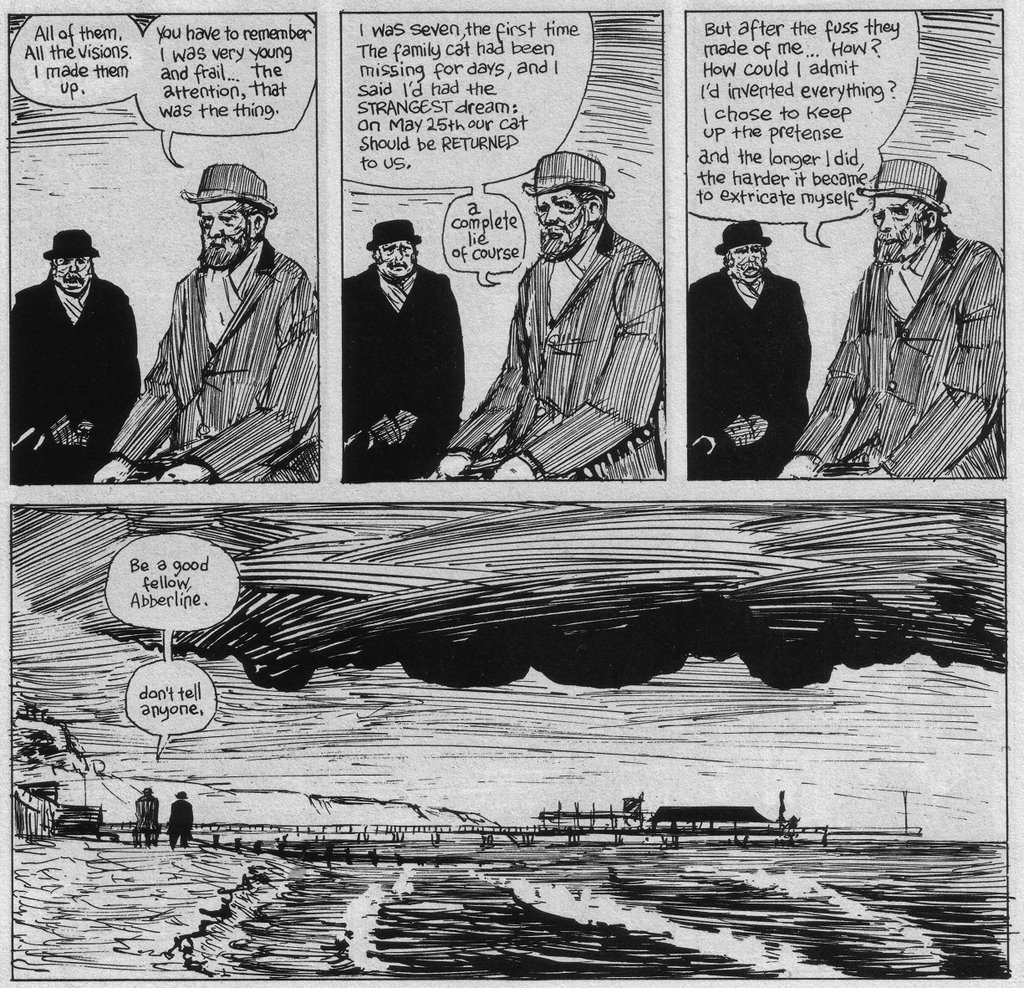
It does raise one disturbing question, though. Why are writers of historical fiction so obsessed with serial killers?
Tuesday, August 01, 2006
Don DeLillo on the JFK Assassination
Also from a not-yet-archived Paris Review interview, circa 1993:
(Also interesting, from the Author's Note in Libra: "Any novel about a major unresolved event would aspire to fill some of the blank spaces in the known record. To do this, I've altered and embellished reality, extended real people into imagined space and time, invented incidents, dialogues, and characters.")
INTERVIEWERDeLillo wrote, among other things, a masterful novel about the Kennedy assassination, Libra. And while, like Sondheim, he seems to view the assassination as almost mystically important, unlike Sondheim, he spends a great deal of time (about a hundred thousand words) justifying his case. So when he talks about "the true and lasting power of [Lee Harvey Oswald's] name," you've got reason to believe it.
You’ve said that you didn’t think your books could be written in the world that existed before the Kennedy assassination.
DELILLO
Our culture changed in important ways. And these changes are among the things that go into my work. There’s the shattering randomness of the event, the missing motive, the violence that people not only commit but seem to watch simultaneously from a disinterested distance. Then the uncertainty we feel about the basic facts that surround the case—number of gunmen, number of shots, and so on. Our grip on reality has felt a little threatened. Every revelation about the event seems to produce new levels of secrecy, unexpected links, and I guess this has been part of my work, the clandestine mentality—how ordinary people spy on themselves, how the power centers operate and manipulate. Our postwar history has seen tanks in the streets and occasional massive force. But mainly we have the individual in the small room, the nobody who walks out of the shadows and changes everything.
(Also interesting, from the Author's Note in Libra: "Any novel about a major unresolved event would aspire to fill some of the blank spaces in the known record. To do this, I've altered and embellished reality, extended real people into imagined space and time, invented incidents, dialogues, and characters.")
Subscribe to:
Posts (Atom)
