This is Baxter at his best, writing historical fiction with an SF sensibility, and proving that the genres are closer in style and creative demands than many readers realise.This is something I've been saying for a while. More on this later.
Friday, September 08, 2006
Guardian - Out of Time
Review of Stephen Baxter's latest. I'm not a huge fan of his, but it does have one nugget:


Thursday, September 07, 2006
Canada and Historical Fiction
An interesting article in MacLeans, which is enough for tonight. I have done much writing and am very tired. And, so you don't have to click blind, an excerpt:
historical fiction is one of CanLit's dominant genres. One reason we love to write it, it's clear, is to create history, to make up for its perceived lack in Canada. Authors also relish the chance -- you can't libel the dead -- to name names and play with real-life characters as they wish. Then again, some writers might be motivated by Prairie author Guy Vanderhaeghe's snarled response to a query about why so much great historical fiction was coming out of Saskatchewan: "Because we've got no f--king future, that's why."Exeunt, to bed.
Wednesday, September 06, 2006
Graphic History: The Golem's Mighty Swing
- The Stars of David are a barnstorming Jewish baseball team in the 1920s, who need something new to draw in attendance. Victor Paige, of the Big Inning Promotional Agency has an idea: he'll get them a golem for a ringer ... Overall, this is a great example of just how to do historical fiction right. Let the history inform the fiction, instead of dictate it.
- The story works for me, I think in part because if it didn't happen, it should have. There were barnstorming Jewish teams, like the House of David, and they did use ringers (like Babe Ruth in a very unconvincing beard). And Negro Leagues players often barnstormed for extra money. Combining the two just feels right, which can be an important quality for historical fiction.
- And, with the exception of the art, Sturm doesn't lean too hard on the history. I'm not downplaying the research. The reference work that must have gone into those drawings had to be grueling. But Sturm is confident enough to let it create atmosphere, instead of dwelling on his research. Instead, he gets ahead with the story.
- Sturm's choice of voice is effective - simple, underplayed. It allows the story to come through, and the characters, without losing anything to visual or verbal pyrotechnics.
- One of the most important things (sadly, not part of the image here) is that Sturm doesn't forget that one of the most important things in a baseball story is drawing the baseball well.
Tuesday, September 05, 2006
The right way to write historical fiction is ...
Obsessive realism? That's the "dominant tradition."
You're better off using shifting time frames? "You can expect readers to get what you're saying about the presence of the past in our present."
Using certain male types, familiar to readers of historical fiction? Like "the good-hearted ... patriarch," the "mysterious friend" and the "hapless ... love."
This is why I'm doing this, because everyone likes pronouncing on how to do this, but only one of them has a PhD in it. (Go ahead, click on the second one, it's a really interesting interview.)
You're better off using shifting time frames? "You can expect readers to get what you're saying about the presence of the past in our present."
Using certain male types, familiar to readers of historical fiction? Like "the good-hearted ... patriarch," the "mysterious friend" and the "hapless ... love."
This is why I'm doing this, because everyone likes pronouncing on how to do this, but only one of them has a PhD in it. (Go ahead, click on the second one, it's a really interesting interview.)
Monday, September 04, 2006
Sunday at Borders - Monday Edition 2
OK, so late with this again, but it's a long weekend, and I know nobody's reading this anyway, so who could be complaining? So, new and reviewed this week ...
Historical Fiction
History
Historical Fiction
- Another Green World, by Richard Grant, reviewed by Ross King in the Washington Post. I read the description with dread: do we really need yet another World War II novel? But the description -- more Pynchon than Wouk, according to King -- has me excited.
- Imperium, by Richard Harris, reviewed by Tom Holland in the Guardian. Holland doesn't seem to like Harris much, which makes it all the more surprising that he loves Imperium. Me, I think it will make for good reading till HBO hits us with the next season of Rome.
History
- First Lady of the Confederacy: Varina Davis's Civil War, by Joan E. Cashin, reviewed by Jonathan Yardley in the Washington Post. Another Civil War history, albeit from the perspective of Jefferson Davis's wife. Sadly, Yardley doesn't seem to identify any way in which this offers something new and different.
- Orson Welles: Hello Americans, by Simon Callow, reviewed by Gary Giddins in the New York Times. I'm a sucker for this from the beginning, since it's Simon Callow. The fact that it covers the period in which Welles made, among other things, The Stranger and Lady from Shanghai pretty much sells it.
- Writers, Readers and Reputations: Literary Life in Britain, 1870-1918, by Phillip Waller, reviewed by Dinah Birch in the Times Literary Supplement. At 1,181 pages, I'm not sure this is one I really need to get; 1,176, sure, but this is just a few too many. Seriously, if I were planning on delving into lesser-known Victorian authors, I think I'd start here.
- An Aristocratic Affair, by Janet Gleeson, reviewd by Sarah Bakewell in the Independent. Harriet Spencer was apparently the Paris Hilton of her day, except here, we get the consequences, in all their schadenfreudenish glory. Yes, "schadenfreudenish" is a word, you should see how many points it gets in Scrabble.
- Love and Louis XIV, by Antonia Fraser, reviewed by Tom Dewe Matthews in the Independent. Apparently, Fraser is trying too hard to make her histories read like novels. Of course, if you're just focusing on who he slept with, there may not be a whole lot of historical arguments you're inclined to make.
- Private Battles, by Simon Garfield, and Invasion, 1940, by Derek Robinson, both reviewed by Robert McCrum in the Guardian. More books on the Battle of Britain, which is one topic I never mind seeing more of. Makes gift-buying for some folks easier.
- Daughter of the Desert: The Remarkable Life of Gertrude Bell, by Georgina Howell, reviewed by Rachel Aspden in the Guardian. Debutante or Oriental Secretary in Baghdad, what is a wealthy heiress to choose? See, now, that's a hook.
Friday, September 01, 2006
Although it sounds like he just got them all drunk ...
An interview with the author of the forthcoming children's book Beethoven's Five Legless Pianos. Which, despite all odds, now intrigues me, just based on this bit:
It is certainly neither “creative nonfiction” or “historical fiction.” It is exactly what it claims to be—a theory on how Beethoven might have moved his five legless pianos in and out of 39 different apartments, and on why he might have felt compelled to move so often, and on what these apartments might have been like, and on what works he might have composed while in the various apartments.
More on Mahfouz
Edward Said remembers Mahfouz in Counterpunch.
To have taken history not only seriously but also literally is the central achievement of Mahfouz's work and, as with Tolstoy or Solzhenitsyn, one gets the measure of his literary personality by the sheer audacity and even the overreaching arrogance of his scope. To articulate large swathes of Egypt's history on behalf of that history, and to feel himself capable of presenting its citizens for scrutiny as its representatives: this sort of ambition is rarely seen in contemporary writers.
Thursday, August 31, 2006
Write-Thinking Folk
OK, so some freelancer named gets himself an article on Slate about Deadwood. That's fine. I like reading about Deadwood almost as much as I like watching it.
And MacIntrye's not enamored of series creator David Milch, which I can also accept. My guess is, after the season finale this year, a lot of people are not enamored of Milch. (I don't happen to be one of them, but I can accept that there are people like that out there.)
I can even accept that he thinks Milch may be a huckster who "dresses up his auteurlike compulsiveness with a professorial bearing and impressive erudition."
Here's where I draw the line. I quote:
I quote again from the illustrious Mr. MacIntyre:
And MacIntrye's not enamored of series creator David Milch, which I can also accept. My guess is, after the season finale this year, a lot of people are not enamored of Milch. (I don't happen to be one of them, but I can accept that there are people like that out there.)
I can even accept that he thinks Milch may be a huckster who "dresses up his auteurlike compulsiveness with a professorial bearing and impressive erudition."
Here's where I draw the line. I quote:
He's given to repeating gauzy platitudes, such as a line from the scientist Friedrich August Kekule, that "what writing should be is a going out in spirit," and this precious aphorism of craft: "You can't think your way to write action; you can only act your way to write thinking."See, here's the thing. Leave aside whether you've ever known anyone into self-help or in any one of a scad of recovery programs. Just Google "think your way into write action." You get "Your search - 'think your way into write action' - did not match any documents." Now Google the homonymic "think your way into right action." (Now, just for fun, try "act your way into [right/write] thinking.")
I quote again from the illustrious Mr. MacIntyre:
The lesson to any would-be TV provocateur: Do the research.Do as he says, not as he does.
Mauger what I've said before ...
I know I've said to be shy of old-fashioning dialogue, but I think the methodology here (combing through old sources for unusual uses of words) is pretty sound. Plus, it's amusing.
How to Speak Nineteenth Century.
How to Speak Nineteenth Century.
Obit - Naguib Mahfouz
This is sad.
He studied philosophy at Cairo University and wrote his first novel in 1939. In the decades since, he had published some 60 more books, including heavily researched historical fiction and sprawling, intricately structured novels about contemporary Egyptian life.
Intensely prodigious throughout his life, he also wrote hundreds of short stories, screenplays, newspaper columns, essays and more.
Wednesday, August 30, 2006
Graphic History: Joan Book I

Joan seemed an interesting selection to discuss for two reasons: (1) it's manga, but about European history, and (2) it deals with an interesting subject, Joan of Arc. But while I had high hopes going in, there was one overwhelming flaw that pulled me out of the story.
- The plot revolves around Emil, another girl dressed as a man, who follows in Joan's footsteps ten years later. The similarities don't end there. She was also raised by Baudricourt, the same man who ostensibly mentored Joan. She also talks to the dead Joan of Arc in visions.
- And I just have to ask: why? If you're going to do a story about a woman in Joan of Arc's period, who dresses as a man and goes to the same places, why not just do the story of Joan of Arc? As it stands, Emil is a pale shadow of Joan.
- It's not like freeing the story from Joan's specific events helps it any. Instead of some strong narrative pull, the reader just gets some meandering from one mild adventure to another.
Tuesday, August 29, 2006
Books: True History of the Kelly Gang
- True History of the Kelly Gang won the Mann Booker Prize in 2001. I picked it up off a remainder shelf in San Francisco, ecstatic to find a Peter Carey novel on the cheap. Which tells you something about the sales power of the Mann Booker Prize in the United States.
- Carey uses a neat device here. While the “found papers” novel is nothing unusual (cf. any epistolary novel ever), he goes so far as to include archival notes, describing each set of documents. They make for a naturalistic way to break the novel up into chapters, and even allow for a old-fashioned “summation” of the story in each chapter.
- Which leads to one question. Why doesn’t the summation doesn’t wreck the narrative tension? Probably because the story isn’t really about what it’s supposed to be about. The Kelly boys are well-known in Australia. So what is the novel about?
- It seems, in part, to be about the ways in which outlaws get mythologized. But, more importantly, it’s about why Ned Kelly decided to write his life story. We know early on that he’s writing it for his daughter, but the reason he wants to pass it on stays hidden, which creates the same kind of tension found in the short story “First Defeat.” It seems that maybe, more than in other kinds of fiction, historical fiction can use this question of why the story exists in the first place to great effect.
- The narrative voice is one of the big attractions of the novel. (In the cover blurbs, Janet Maslin calls it one of the great acts of literary ventriloquism.) It’s effective, too, once you get used to it. I was concerned at first that it sounded too contrived, but I found myself considering it normal after about fifty pages. (Before that, it was work, but rewarding work.) It’s far from flowery. Instead, it’s hot-blooded but halting, earthy, but with the restraint of a man who’s trying not to set a bad example for the daughter he barely knew. The more one learns about Kelly, the more the voice in this novel seems a real achievement.
- Not that the novel is flawless. (Brilliant, just not flawless.) One question that bothered me: why does Carey start with the incident where Kelly improvises body armor in a gunfight? It’s an arresting image, but it’s not like the incident drives the story. And it’s not like he plays a whole lot with chronology otherwise. So what purpose does the flashforward serve? As is, it feels kind of like a bad JJ Abrams trick.
Some More New and Reviewed
Procrastinating on something else, and trying to clear out some of my backlog, so:
Saint Patrick's Battalion, by James Alexander Thom, reviewed by Danny Lee in the Indianapolis Star. I've read about this incident -- recent Irish-American immigrants joining the Mexicans in the Mexican-American war -- somewhere else in a historical fiction context, where it was a story within a story. Good to see it getting a more prominent treatment.
The Lambs of London, by Peter Ackroyd, reviewed by Kelly Jane Torrance in the Washington Times. More Shakespeariana, but at least it's focusing on some of the earliest Shakespearianists -- the folks who brought us the abridged Tales from Shakespeare. Ackroyd tends to be pretty interesting, though, so it may be worth picking up.
Brief Encounters with Che Guevara: Stories, by Ben Fountain, reviewed by Jim Ruland in the Los Angeles Times. This is the second time I've seen this reviewed (and reviewed well), and the first that mention that the stories explore historical themes. I'll be picking this one up, if for no other reason than I've been pondering historical shorts a lot lately.
Saint Patrick's Battalion, by James Alexander Thom, reviewed by Danny Lee in the Indianapolis Star. I've read about this incident -- recent Irish-American immigrants joining the Mexicans in the Mexican-American war -- somewhere else in a historical fiction context, where it was a story within a story. Good to see it getting a more prominent treatment.
The Lambs of London, by Peter Ackroyd, reviewed by Kelly Jane Torrance in the Washington Times. More Shakespeariana, but at least it's focusing on some of the earliest Shakespearianists -- the folks who brought us the abridged Tales from Shakespeare. Ackroyd tends to be pretty interesting, though, so it may be worth picking up.
Brief Encounters with Che Guevara: Stories, by Ben Fountain, reviewed by Jim Ruland in the Los Angeles Times. This is the second time I've seen this reviewed (and reviewed well), and the first that mention that the stories explore historical themes. I'll be picking this one up, if for no other reason than I've been pondering historical shorts a lot lately.
Monday, August 28, 2006
Sunday at Borders, 27 August 2006 - Special Monday Edition
Traveling over the weekend, so this is a day late. Sorry. Among the new and reviewed this week:
Historical Fiction
The Law of Dreams, by Peter Behrens, reviewed by Ron Charles in the Washington Post. Peter Behrens makes his literary debut with a story of the Great Famine of 1847 (more popularly known as the Irish Potato Famine). The story looks interesting, even if reviewer Charles seems enthralled by just how many ways to describe hero Fergus O'Brien's suffering.
Sovereign, by CJ Sansom, reviewed by Jane Jakeman in the Independent. The third in a series starring Matthew Shardlake, the hunchbacked lawyer in Henry VIII's court. Jakeman praises Sansom's evocation of "contemporary horrors ... [t]his is no herbs-and-frocks version of Tudor England." Because, Lord knows, we've all seen entirely too many herbs and frocks 'round these parts.
The Pure Land, by Alan Spence, reviewed by David Isaacson in the Independent. Shogun with a Scotsman, in which "action takes precedence over character." Pity.
History
The Reluctant Mr. Darwin: An Intimate Portrait of Charles Darwin and the Making of His Theory of Evolution, by David Quammen, reviewed by Adrian Desmond in the New York Times, and by David Brown in the Washington Post. Oh look, another Darwin biography ... Desmond spends half the review on "the Darwin industry" (which he's working on joining himself), but says this latest edition is a "plucky condensation." Brown just tries to tie it into yet another summary of the debate over Intelligent Design.
Selected Letters of Martha Gellhorn, edited by Caroline Moorehead, reviewed by Francine du Plessix Gray in the New York Times. Gellhorn was apparently the "greatest female war correspondent of the mid-century decades," which may be the greatest quoted superlative in an August linkblogging entry. The letters themselves sound interesting, though, combining the substance of a war correspondent's correspondence with what Gray says is Flaubert-level prose.
A Life in Secrets: Vera Atkins and the Missing Agents of WWII, by Sarah Helm, reviewed by Selwa Roosevelt in the Washington Post. Atkins worked for Britain's Special Operations Executive -- a wartime covert intelligence outfit -- despite the fact that she was of Romanian birth herself, and therefore "technically an enemy alien." She served as a spymaster for female agents in World War II. If that description hasn't sold you, check yourself for vital signs.
Waxing Mythical: The life and legend of Madame Tussaud, by Kate Berridge, reviewed by Marianne Brace in the Independent. The infamous mistress of waxworks predated PT Barnum by more than a century. And Brace seems to think Tussaud could teach him a thing or two.
Shakespeare and Co.: Christopher Marlowe, Thomas Dekker, Ben Jonson, Thomas Middleton, John Fletcher and the Other Players in His Story, by Stanley Wells, reviewed by Simon Callow in the Guardian. Oh look, another book about Shakespeare ... But Simon Callow wrote the review, so go read it.
Historical Fiction
The Law of Dreams, by Peter Behrens, reviewed by Ron Charles in the Washington Post. Peter Behrens makes his literary debut with a story of the Great Famine of 1847 (more popularly known as the Irish Potato Famine). The story looks interesting, even if reviewer Charles seems enthralled by just how many ways to describe hero Fergus O'Brien's suffering.
Sovereign, by CJ Sansom, reviewed by Jane Jakeman in the Independent. The third in a series starring Matthew Shardlake, the hunchbacked lawyer in Henry VIII's court. Jakeman praises Sansom's evocation of "contemporary horrors ... [t]his is no herbs-and-frocks version of Tudor England." Because, Lord knows, we've all seen entirely too many herbs and frocks 'round these parts.
The Pure Land, by Alan Spence, reviewed by David Isaacson in the Independent. Shogun with a Scotsman, in which "action takes precedence over character." Pity.
History
The Reluctant Mr. Darwin: An Intimate Portrait of Charles Darwin and the Making of His Theory of Evolution, by David Quammen, reviewed by Adrian Desmond in the New York Times, and by David Brown in the Washington Post. Oh look, another Darwin biography ... Desmond spends half the review on "the Darwin industry" (which he's working on joining himself), but says this latest edition is a "plucky condensation." Brown just tries to tie it into yet another summary of the debate over Intelligent Design.
Selected Letters of Martha Gellhorn, edited by Caroline Moorehead, reviewed by Francine du Plessix Gray in the New York Times. Gellhorn was apparently the "greatest female war correspondent of the mid-century decades," which may be the greatest quoted superlative in an August linkblogging entry. The letters themselves sound interesting, though, combining the substance of a war correspondent's correspondence with what Gray says is Flaubert-level prose.
A Life in Secrets: Vera Atkins and the Missing Agents of WWII, by Sarah Helm, reviewed by Selwa Roosevelt in the Washington Post. Atkins worked for Britain's Special Operations Executive -- a wartime covert intelligence outfit -- despite the fact that she was of Romanian birth herself, and therefore "technically an enemy alien." She served as a spymaster for female agents in World War II. If that description hasn't sold you, check yourself for vital signs.
Waxing Mythical: The life and legend of Madame Tussaud, by Kate Berridge, reviewed by Marianne Brace in the Independent. The infamous mistress of waxworks predated PT Barnum by more than a century. And Brace seems to think Tussaud could teach him a thing or two.
Shakespeare and Co.: Christopher Marlowe, Thomas Dekker, Ben Jonson, Thomas Middleton, John Fletcher and the Other Players in His Story, by Stanley Wells, reviewed by Simon Callow in the Guardian. Oh look, another book about Shakespeare ... But Simon Callow wrote the review, so go read it.
So What Is Historical Fiction?
It’s a good question. Because, given enough time, all fiction gets to be historical. And that makes me rethink what I said last week about genre being a shelf in the bookstore. That’s not a bad start, but keeping the metaphor physical like that may limit our understanding of genre, we start thinking “one book, one shelf,” which leads bookstores to put Toni Morrison’s Beloved in African-American Literature, and nowhere else.
It may be that genre is a tag. It’s not that it has characteristics that make you put it on the historical fiction shelf as opposed to in general fiction. Instead, it has characteristics that allow you to put a sticker on it that says “Historical Fiction.” You can put a lot of other tags on it as well, but this one clearly belongs.
So what are the characteristics? I’ve heard some say that historical fiction is fiction written about a time before the author lived. But that isn’t quite right – that gets limiting. It excludes Phillip Roth’s Plot Against America, and Don DeLilo’s Libra, both of which I’d say are I’d say historical fiction, even though Phillip Roth has inserted his childhood self into one, and DeLilo clearly lived through the Kennedy assassination.
One of historical fiction’s weird strengths is that it is so broad. Basically, anything that happened in the past is the subject of historical fiction. But it seems silly to call John Updike writing about his boyhood “historical fiction,” no matter how long ago that was. Better example --- Shakespeare wrote a number of plays that are referred to as the Histories. Why? Because they were about British history, and the primary reason to watch them was to get an idea of who and what came before.)
So maybe historical fiction is simply fiction that is concerned with history. It’s not a great definition, but it serves my purposes for the time being. And I think, as I wind up looking at more of the problems and the techniques unique to historical fiction, I’ll be able to refine the definition.
It may be that genre is a tag. It’s not that it has characteristics that make you put it on the historical fiction shelf as opposed to in general fiction. Instead, it has characteristics that allow you to put a sticker on it that says “Historical Fiction.” You can put a lot of other tags on it as well, but this one clearly belongs.
So what are the characteristics? I’ve heard some say that historical fiction is fiction written about a time before the author lived. But that isn’t quite right – that gets limiting. It excludes Phillip Roth’s Plot Against America, and Don DeLilo’s Libra, both of which I’d say are I’d say historical fiction, even though Phillip Roth has inserted his childhood self into one, and DeLilo clearly lived through the Kennedy assassination.
One of historical fiction’s weird strengths is that it is so broad. Basically, anything that happened in the past is the subject of historical fiction. But it seems silly to call John Updike writing about his boyhood “historical fiction,” no matter how long ago that was. Better example --- Shakespeare wrote a number of plays that are referred to as the Histories. Why? Because they were about British history, and the primary reason to watch them was to get an idea of who and what came before.)
So maybe historical fiction is simply fiction that is concerned with history. It’s not a great definition, but it serves my purposes for the time being. And I think, as I wind up looking at more of the problems and the techniques unique to historical fiction, I’ll be able to refine the definition.
Saturday, August 26, 2006
History and Film: Apollo 13
Should have posted this yesterday, but I was traveling. Also, no picture this time.
- Think this one is largely workable. The consensus is that it creates suspense even though you know the outcome.
- Hanks gives some expositional dialogue in the beginning that works because it has a couple of purposes. It gets across the exposition, but it also expresses Lovell’s frustration. Ditto with the tour. Is it a sales pitch? Yes, to the overseers to keep the program going. “If there is an Apollo 14.” There’s your stakes.
- Some of the “isn’t it quaint?” moments stick out, though. Computer that fits in room. “Is she still mad because the Beatles broke up?”
- Some natural advantages. Apollo 13 makes for nice foreboding. (And they keep the bad omens to Marilyn Lovell, which is smart.) The “it actually happened” part of the story works here, particularly when it needs to lend weight the additional crises that come in by the end. In a purely fictional movie, having to land through a storm would just be too much. Knowing that was what actually happened? The tension ratchets that much more.
Small glitch with the launch (“the clock is running …”) keeps it from being clichéd, even though Howard uses the expected beats. (He also cuts inside, and to Sinise’s POV, which switches it up a little.) The glitch also helps with tension against the facts. (“Looks like we just had our glitch for this mission.”) - The themes in the movie are grand, but the execution is earthy at points. “How do you go to the bathroom up there?” “Flight surgeon horseshit.” “Eat the ass off a dead rhinocerous.” “Constellation Urine.” “No more waste dumps.” “It hurts when I urinate.” It works. It keeps it from falling for its own bullshit. Getting too lofty.
- There is some highly technical stuff to deal with in this movie. That could have been boring, but it’s not. The actors help in selling some of it. Howard also cuts back to ground – built-in Greek chorus, sells us on danger from reactions. The earthier tone also works in delivering technical dialogue. There’s some rough poetry to learning that the rockets have developed a “Wicked bang and shimmy.”
- Showing the problem as it occurs works. Keeps the audience grounded, even if the astronauts don’t quite know what’s going on yet. Plus, we know it’s coming, so why be coy?
- The cigarettes in Mission Control are a nice way of indicating what a different time this was. As are the low-tech wonders. When the engineers pull out slide rules to double-check Lovell’s math, my reaction was: Slide rules? They did their navigation with slide rules?
- People with common goals but cross-purposes. Good example, as he tries to come up with a power-up procedure, Ken Mattingly talks about needs, his tech talks about what they have. They’re all after the same thing, but that interim conflict keeps tension high.
- The voiceover at the end may be a little too much. I know it comes from the book, and I know it’s making a good point, but it just feels like too many tacked-on voiceovers before it.
Thursday, August 24, 2006
Fiction: Quicksilver
So this is the real meat of what I wanted to do with this blog. I've been reading a lot of historical fiction in the past year or so, and I wanted a place where I could think out loud about technique in the stuff I was reading. Why start with Quicksilver? Two reasons. One, for all what I say below may sound critical, I thought it was a great read. And, two, because, while I had read historical fiction before (I mean, who growing up where I did could avoid Johnny Tremaine?), this was the first piece that really made me think consciously about method. And, I think it did, because it’s kind of a crossover piece.
Stephenson started out as a science fiction writer. (Snow Crash, The Diamond Age.) He had a mainstream hit with Cryptonomicon. After that, he started on the Baroque Cycle, of which this is the first volume. And he’s pretty transparent about taking some of the obsessions and techniques of science fiction and using them in his historical fiction. There is no doubt that this is historical fiction, but it feels different than something that Bernard Cromwell, or Dorothy Dunnett, or Phillippa Gregory might write. So, we’ll start here. (And, needless to say, some SPOILERS below.)
Stephenson started out as a science fiction writer. (Snow Crash, The Diamond Age.) He had a mainstream hit with Cryptonomicon. After that, he started on the Baroque Cycle, of which this is the first volume. And he’s pretty transparent about taking some of the obsessions and techniques of science fiction and using them in his historical fiction. There is no doubt that this is historical fiction, but it feels different than something that Bernard Cromwell, or Dorothy Dunnett, or Phillippa Gregory might write. So, we’ll start here. (And, needless to say, some SPOILERS below.)
- There’s crossover with Cryptonomicon (among other things, the main characters are Shaftoes and Waterhouses), which is a nice marketing technique. It pulls in people who otherwise might have been turned off by the length or the historical period. Remember that last really long book you read and loved? Here’s more of the same. Sort of.
- In fact he starts the book with Enoch Root, who one assumes is a predecessor of the Enoch Root in Cryptonomicon. ("Enoch rounds the corner just as the executioner raises the noose above the woman's head.") Why another Enoch Root? Now that I’ve finished, I think I know, but, I have to admit, this one bugged the hell out of me for nigh-on 2,700 pages.
- And the length is an issue. In hardcover, this book is a whopping 916 pages of narrative, and there is no question that, with something this long, there can be vast stretches where the thing drags. I was talking to a work colleague about this, and he mentioned that he likes long books like this because he can skim past the stuff he finds less interesting to get to the stuff that appeals to him. I can understand some of that impulse, but in a market already saturated with books, do you really need to throw three 300 page books into one? (You think I'm kidding? Stephenson has now released the Baroque Cycle as an eight-volume series, of which the first three volumes are titled Quicksilver, King of the Vagabonds, and Odalisque -- the three "books" in the Quicksilver I read.)
- One other issue is that, for all its length, this is definitely the first of a trilogy. It doesn’t really have its own beginning, middle and end. While the Waterhouse operation makes for a nice cliffhanger, it makes it tougher to read the Confusion, because you know that you won’t get a satisfying chapter out of it.
- Another reason for the occasional drag is that Stephenson does love his exposition. Granted, that's part of the hook here. He's good at exposition. But it works much better when he’s doing it as part of the narration than when he does it as dialogue (of which there are long stretches). His voice works well as narration. His dialogue, while not bad, can get didactic. (More on this in the later volumes.)
- He does take great pains to keep the plot moving, just in case you thought it was all going to be long historical lectures. So he starts off early getting you to the King of the Vagabonds -- a character that promises tours of the seedy underbelly of Europe.
- One thing Stephenson does a great job of in here is playing with language. Some of it is minor variations in spelling, "mathematick," "philosophick." But then occasionally he'll switch it up even more, using “phant’sy” for “fancy,” giving you an idea of the etymology. And then he will introduce as if it were a new concept the hotel, a French word for "private compound of nobles." The language is in a state of flux during this period, and Stephenson goes to pains to show that. At times it borders on the overly cute, but for the most part, it allows him to strike a colloquial tone while still maintaining that this the past is a foreign country. THIS is the stuff that gets me excited about Stephenson.
Wednesday, August 23, 2006
Graphic History: Archangel
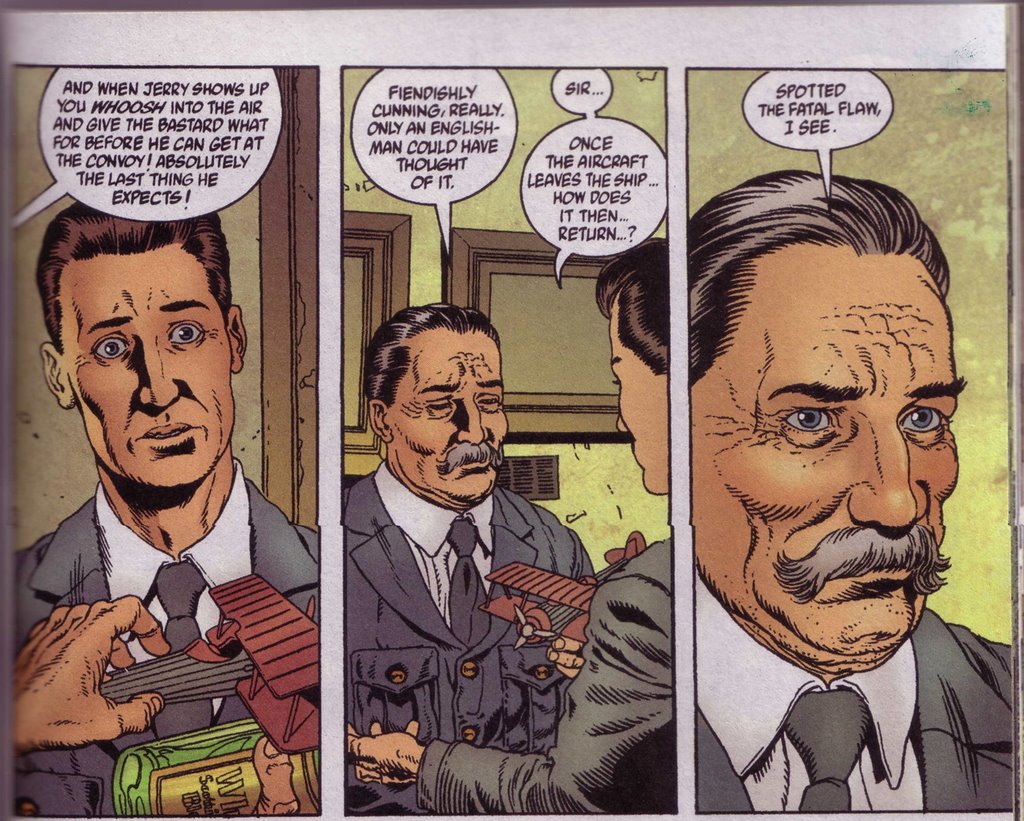
'Sbeen a busy week, so, once again, I'm going to keep this one short. I was hoping to go a little longer before going to the WWII well (because so many people dip into it in historical fiction), but War Stories: Archangel by Garth Ennis and Gary Erskine is such a great shorter piece, I thought it was worth doing now quickly. So:
- The three panels above give the hook, which grabbed me the first time I read it. Camships protected convoys in WWII. They were launched from smaller boats like a catapult when a German squadron came. There was usually one to a convoy. And they had no place to land. Think on that. No. Place. To. Land. You know, except the North Atlantic. Powerful hook.
- So what kind of a person pilots one of these things? He's either got to be crazy, or just plain dumb unlucky. Ennis goes for the second, which actually works very well for the story, because flying the camship (which is what the story is about) is only one of a series of escalating disasters for the lead character. One of the others? The lead gets assigned to the camship for (unintentionally) shooting his own officer in the air -- a documented problem that doesn't often get addressed in war fiction, and certainly not comically.
- This is the lightest of Ennis's War Stories series (which comprises eight one-shots so far, collected in two trade paperbacks).
- One excellent sequence is a montage -- four or five panels in rapid succession, each just another instructor explaining just how bat$#!+ crazy flying one of these things is.
- Ennis does the appendix thing with these, and I think it works. Talking about what you tried to get right and what you deliberately changed definitely helps sell the "painless history" part of your historical fiction. More on this later, as this is one of those things I'm wrestling with.
- That's it for right now. Like I said, short. But I enjoy the hell out of this story.
Tuesday, August 22, 2006
Not Just Fancy Dress
Oddly meandering and inconsquential column, but the last paragraphs include the result of a quick interview with Sarah Waters, who wrote The Night Watch, a book that is on my to-buy-and-read list. The following small bit hits some of the stuff I'm struggling with myself:
Taking her cue from novelist Mary Renault, who said that "the past isn't justThat's it for now.
full of us in fancy dress", she believes that good historical fiction should
take you back into a different mentality.
Monday, August 21, 2006
Why Historical Fiction?
So I’ve got this blog, and I’ve been posting to it regularly for almost a month now. I keep linking these things that catch my interest, and I keep saying the same thing to myself: “I’ll think more about this later.” Well, it’s later.
Because, after all, genre is really a way of shelving books in a store. And, in that way, genre is helpful. It answers our questions when we say “I’m in the mood for X, where do I find that that in the bookstore?”
There’s a reason a reader goes to that shelf. If you’re reading science fiction, chances are you want some cool technology or some future shock. If you’re reading a romance, there’d better be some exotic settings, breathless descriptions, and Fabio on the cover.
Most shelves have unique sets of problems the storyteller has to solve. And there may be specific tools that are well-suited for solving them. (And some not as well-suited, that people insist on using anyway.)
On top of that, writers and readers can, sometimes consciously and sometimes not, create traditions that create expectations for readers. Over time, these traditions can ossify into clichés, or even hard-and-fast “rules” that prevent innovation. Then, genre can wind up as a ghetto. “Spaceships? That’s not literature. Go to science fiction.” And you can only graduate from the ghetto if you write some non-genre stuff good enough to be accepted as literature. So William Gibson’s Pattern Reognition – a stark, present-day novel about a trendspotter with nearly no fantastic elements – gets shelved in Science Fiction, but Margaret Atwood’s Handmaid’s Tale winds up in Fiction/Literature. (Personally, I think you should shelve them both in both places. But I don’t run a bookstore, and there’s probably good reasons for that.)
Unlike mysteries, unlike science fiction, unlike horror, unlike Westerns (which, if you think about it, are just a specialized historical fiction), historical fiction doesn’t get ghettoized in bookstores. It sits happily on the “Fiction/Literature” shelf. That’s both a good and a bad thing. It’s good, because it means that many authors don’t feel any compunction about writing something set before they were born, and don’t have to worry about whether they’re going to get slotted into a specific shelf on the bookstore.
So why is it bad? Because historical fiction is in a weird spot right now. Most bookstores don’t have a Historical Fiction section, but say the words “historical fiction,” and you’ve created a set of expectations in your listener. So, if you write something, and you call it “historical fiction” (or even if you just set it in the past) then you have to deal with the expectations, because they’ll be sitting there in your reader’s head. The lack of a shelf masks that fact for a lot of people.
One of the good things about genre is that, once it has its own shelf in the bookstore, you get people who think hard about the problems specific to the books on that shelf. There are people who think very hard about science fiction, and romance, and mysteries. A lot of that thinking is crap –constant walling off of what is and isn’t part of the genre, almost-fractal subdivision of genres, endless invention of clever labels. But some of it is genuinely useful.
And, because there are specific problems with writing about history, historical fiction has some problems, some tools, and, of course, some bad habits that are, if not unique to it, at hard for it to deny under oath. It’s worth thinking hard about those, even if it doesn't have its own shelf. And that’s what I want to do here.
Some of this stuff has been sitting in my head a while. I figure I’ll be posting like this about once a week as I think through some of this stuff. I’ll try to figure out a way to label it so people know to skip the long, rambly pieces. Of course, the fact that they’re long is probably a tipoff.
Because, after all, genre is really a way of shelving books in a store. And, in that way, genre is helpful. It answers our questions when we say “I’m in the mood for X, where do I find that that in the bookstore?”
There’s a reason a reader goes to that shelf. If you’re reading science fiction, chances are you want some cool technology or some future shock. If you’re reading a romance, there’d better be some exotic settings, breathless descriptions, and Fabio on the cover.
Most shelves have unique sets of problems the storyteller has to solve. And there may be specific tools that are well-suited for solving them. (And some not as well-suited, that people insist on using anyway.)
On top of that, writers and readers can, sometimes consciously and sometimes not, create traditions that create expectations for readers. Over time, these traditions can ossify into clichés, or even hard-and-fast “rules” that prevent innovation. Then, genre can wind up as a ghetto. “Spaceships? That’s not literature. Go to science fiction.” And you can only graduate from the ghetto if you write some non-genre stuff good enough to be accepted as literature. So William Gibson’s Pattern Reognition – a stark, present-day novel about a trendspotter with nearly no fantastic elements – gets shelved in Science Fiction, but Margaret Atwood’s Handmaid’s Tale winds up in Fiction/Literature. (Personally, I think you should shelve them both in both places. But I don’t run a bookstore, and there’s probably good reasons for that.)
Unlike mysteries, unlike science fiction, unlike horror, unlike Westerns (which, if you think about it, are just a specialized historical fiction), historical fiction doesn’t get ghettoized in bookstores. It sits happily on the “Fiction/Literature” shelf. That’s both a good and a bad thing. It’s good, because it means that many authors don’t feel any compunction about writing something set before they were born, and don’t have to worry about whether they’re going to get slotted into a specific shelf on the bookstore.
So why is it bad? Because historical fiction is in a weird spot right now. Most bookstores don’t have a Historical Fiction section, but say the words “historical fiction,” and you’ve created a set of expectations in your listener. So, if you write something, and you call it “historical fiction” (or even if you just set it in the past) then you have to deal with the expectations, because they’ll be sitting there in your reader’s head. The lack of a shelf masks that fact for a lot of people.
One of the good things about genre is that, once it has its own shelf in the bookstore, you get people who think hard about the problems specific to the books on that shelf. There are people who think very hard about science fiction, and romance, and mysteries. A lot of that thinking is crap –constant walling off of what is and isn’t part of the genre, almost-fractal subdivision of genres, endless invention of clever labels. But some of it is genuinely useful.
And, because there are specific problems with writing about history, historical fiction has some problems, some tools, and, of course, some bad habits that are, if not unique to it, at hard for it to deny under oath. It’s worth thinking hard about those, even if it doesn't have its own shelf. And that’s what I want to do here.
Some of this stuff has been sitting in my head a while. I figure I’ll be posting like this about once a week as I think through some of this stuff. I’ll try to figure out a way to label it so people know to skip the long, rambly pieces. Of course, the fact that they’re long is probably a tipoff.
Subscribe to:
Posts (Atom)